All Blogs
How Long Should a Resume Be? (2026 Guide)
Your resume should be 1 page if you have under 5 years of experience and 2 pages after that - recruiters prefer two-page resume. see the rules by experience level.
Your resume has 7.4 seconds to survive a recruiter's scan, according to a 2018 Ladders eye-tracking study. So, when writing a resume, you need to know exactly how long a resume should be.
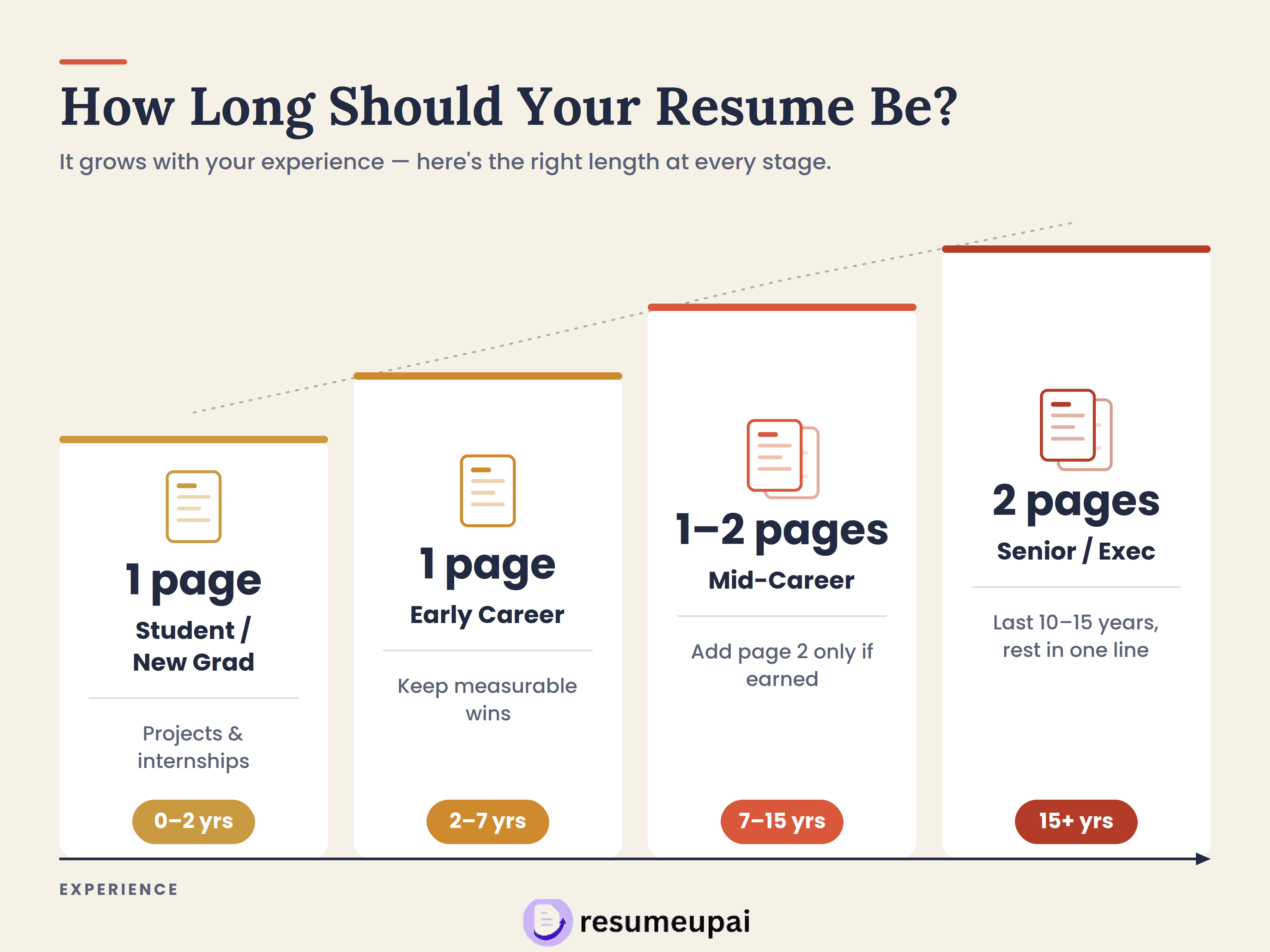
Your resume should be one page if you have under 7 years of experience, one or two pages for 7–15 years, and two pages if you have 15+ years. Three pages are reserved for academic, medical, and C-suite roles.
TL;DR
A resume for beginners, early career, and new graduates should be 1 page. For mid-career professionals, 1 or 2 pages is fine. When coming to seniors or executives, 2 pages is the best choice. 3 pages are correct only for academic, medical, and C-suite roles.
Experience level | Resume Length | When to extend |
|---|---|---|
Student / new graduate (0–2 years) | 1 page | Never — filled with projects, internships, coursework |
Early-career (2–7 years) | 1 page | Only if specialized certifications or publications apply |
Mid-career (7–15 years) | 1–2 pages | Extend to 2 pages when the leadership skills need to be highlighted |
Senior / executive (15+ years) | 2 pages | Extend to 3 pages only for academic or C-suite roles |
How Long Should a Resume Be by Experience Level?
The right length depends on how much relevant experience you have, but don't force everything onto one page to follow an old rule. In a hiring study of 482 recruiters covered by CNBC, recruiters preferred 2-page resumes 2.3 to 1 when the candidate's experience justified the second page.
Students and new graduates (0–2 years)
Keep your resume to one page. Recruiters find everything they need on one page. A second page dilutes your best work instead of adding to it.
Lead every bullet with a result: "Automated a weekly report that saved 4 hours" beats "Responsible for reporting."
Fill the page with internships, academic projects, coursework, and leadership activities.
Pull keywords from the job description so your page matches what employers search for - a job description keyword finder does this fast.
List your GPA only if it is 3.5 or higher - Recruiters increasingly skip it for skills and projects.
Early-career professionals (2–7 years)
Stick to a 1-page resume. The few years fit easily, and the limit forces you to keep only the achievements that prove you can do the job.
Spend most of the space on your recent work experience and previous role.
Condense your first job after graduation into one line if you’ve gained additional experience.
Remove responsibilities that anyone could take credit for - use a resume bullet point generator to turn them into measurable wins.s
Go for a 2-page if it's a hard requirement: clearance, license, or portfolio.
Mid-career professionals (7–15 years)
You can use one or two pages. A second page is best, but only if your accomplishments justify the extra space - at this level, you can't fit a decade of experience on one page.
Start strong on page one, since many recruiters won’t even turn the page.
Mention numbers: team, budget, revenue, or number of users impacted.
If your results barely extend to a second page, condense to one page.
Add a skills or core competencies section near the top.
Senior professionals and executives (15+ years)
Default 2 pages. A one-page resume may hide what you have done, and recruiters expect more from a senior or executive candidate. Purdue University's Online Writing Lab gives the same advice: go to 2 pages when your content earns it, and make sure page one can stand on its own.
Provide room for the last 10 to 15 years of your experience
Condense everything from more than 15 years to just a single line
Use the third page for anyone in the C-suite, a board member, or with a patent- or publication-heavy background
Detail the last 3 or 4 jobs, and then summarize the rest
Exception (regardless of your experience level)
Most federal resumes are now capped at 2 pages. The US Office of Personnel Management has set a two-page limit across all USAJOBS postings, and a longer resume makes you ineligible.
When Is a Three-Page Resume Acceptable?
A three-page resume is acceptable in three specific situations: academic CVs, medical and clinical roles, and senior executives with extensive records. If you don't fall under these three, an ATS-friendly two-page template keeps you focused.
Academic CVs
Academic CVs have no page limit - which often exceeds 3-pages. Professors, scientists, and postdocs need to mention every publication, grant received, conference presentation attended, and course taught.
Medical and clinical roles
Physicians, surgeons, and clinical researchers' resumes should be three pages or more. Licenses, board certifications, and residencies don't fit on two pages.
Senior executives with extensive records
A third page can be used by senior management professionals such as CEOs, COOs, CXOs, and directors with long records of publications or board membership. Even here, the third page needs only information regarding their impact; any other earlier job should not be mentioned on the third page.
What Is the 7-Second Rule for the Resume?
The 7-second rule means that recruiters only look at your resume for about 7.4 seconds to determine whether they will read on further or not. In short, your resume gets one glance before a decision.
Key Takeaway: The top third of page one makes the decision. The recruiter will already have decided whether to get to your second page or not, so your best points need to be at the top.
To win the 7-second scan, you have to write these 5 sections at the top
The header should have your name, location, and your desired job title
2-3 lines of text explaining your experience level and the target job
Your most recent work position is highlighted and dated on the right-hand side
At least three of your major accomplishments that contain numbers under your most recent job position
Listing relevant keywords based on the desired job description
Conclusion
The length of your resume depends on your experience level – a 1-page resume for beginners, a 2-page resume for seniors. Get the length right, then spend your time on what fills it: keywords and bullets that prove you fit the job.
To save time on formatting and spacing, an AI resume builder manages the layout and keeps it to the right length automatically, so you can actually focus on what really matters rather than design.
Frequently Asked Questions
Is a two-page resume OK?
Yes, a 2-page resume is suitable when you have around 7+ years of experience, and it is the default for senior-level professionals/executives who have more than 15 years of experience. If you have less than 7 years of experience, keep your resume on one page only.
What is 7 second rule in resume?
The 7-second rule refers to the fact that recruiters spend 7.4 seconds on your resume initially. During this period, the recruiter is not reading your resume; they are looking for key points. If your key strengths are not within the top third of page one of your resume, then your resume may never get noticed.
Would the resume builder platform consider how detailed a resume should be?
Yes, the resume builder is the best platform to get the most desirable resume with the higher chances of shortlisting the candidature. The platform will manage the resume's length while ensuring that all the essential details are mentioned.
How long should a resume be for 10 years of experience?
One or two pages. With 10 years of mid-career experience, one page works if your achievements are tight end, while two pages are deserved for leadership results or budget figures to show. Start your resume with your best and most recent achievements on page one.
How do I shorten my resume to one page?
Use results rather than duties as bullet points – "Reduce report completion time by 4 hours" is better than "Reporting responsibilities"
Limit to 3–4 bullets per position and omit any bullets that are generic
Include only relevant course work, projects, and internships
Format in one column with proper spacing; no need for large margins or big heading fonts
Don't mention your GPA if it's less than 3.5,

Rohith Reddy
Co-Founder
Rohith Reddy is the co-founder of ResumeUp.AI and a former hiring manager who conducted 500+ technical interviews over a decade at companies including ADP. His hiring-market research at ResumeUp — including studies on ghost jobs and AI's impact on entry-level hiring — has been covered by Entrepreneur. A Computer Science graduate, he writes about what recruiters and ATS systems actually reward, from both sides of the hiring table.