All Blogs
130+ Skills to Put on Resume in 2026 (Templates & Examples)
Find the best skills to put on your resume in 2026. Explore 130+ examples with templates for different roles and industries. Enhance your resume with right skills.
The skills section is the first thing an employer and the ATS read on your resume, and listing the right skills for the job decides whether you get shortlisted or filtered out.
Over 99% of Fortune 500 companies use an ATS to filter out resumes; the keywords in your skills section matter before a recruiter ever sees the resume. A corporate role draws around 250 applicants, yet only 4 to 6 candidates get an interview, so the right skills are what make your resume stand out from the 240+ applicants.
This guide helps you decide which hard, soft, and transferable skills to include on your resume, organized by industry and role, so you can tailor your skills section to any job and pass both the ATS and recruiter scans.
Quick Summary: Skills on a Resume
The right resume skills are the ones that match the specific job you are targeting, not just a long list. Include three types of skills: hard skills(technical, job-specific), soft skills (how you work with people), and transferable skills(strengths that apply to any role). Use the keywords from the posting, since ATS matches with exact terms, not synonyms. Spread the skills throughout the resume, like the most relevant skills in the skills section, back them with results in the summary, and work them into your experience.
Why Does Your Resume Skills Section Matter?
Your resume skills section matters because recruiters look at your skills first, which is the fastest way of deciding whether you fit the role or not.
Imagine you are a hiring manager: You have a pile of resumes in front of you. What's the first thing you look for? Skills.
Skills are the main basis for making a strong impression on the employer. So it is always essential to have insight into which skills should be mentioned for that particular job. Using an AI resume builder can help you identify and present the right skills. How will you know which skill to mention on your resume for your applied job?
Why are the Right Skills Important for a Job?
Listing the right skills is very important because your resume impresses an employer when the skills match what that specific role needs. A medical officer highlighting software skills or someone applying for a software developer role listing pharmaceutical knowledge sends the wrong signal. So while listing the skills is necessary, listing the right skills is more necessary.
You have listed the skills on your resume, and now you're all ready to apply for the job with your resume. But believe it when we say listing the skills is only part of the recipe for getting shortlisted. You are just halfway there. The remaining path is not just the skills, but the "right" skills on your resume.
We provided a detailed outline of the skills that should be highlighted on your resume. Skills are the first components of a resume to be glanced at, as they provide a snapshot of your eligibility for the job. Not only do they inform the employer about your talents, but they also highlight your interpersonal behaviors and overall personality, helping to attract the employer.
How Do You Get the Right Skills for a Job Description?
You can get the right skills by matching your resume to the keywords in the job posting. According to HBS, 88% of employers say their ATS screens out high-skilled candidates simply because their resumes don't match the job's exact criteria.
So even a strong candidate can get filtered out for using "client management" when the posting says "client relationship management," or for leaving out a tool the role specifically asks for. The fix isn't adding more skills, it's adding the right ones, placed the way the job posting wants them.
To pull the right skills from any job posting:
Read the job description closely and mark every skill, tool, and qualification, especially in the requirements or responsibilities section.
Mirror exact wording. The ATS matches phrases, not meanings.
Prioritize the must-haves. Lead the skills that are repeated in the job posting.
Drop what's irrelevant for the job posting.
A free skills generator reads how the ATS works and builds a personalized skills section for the role you're targeting — saving you time by doing the work automatically.
Which Type of Skills Should You Include on a Resume?
You should include 3 types of skills on a resume: hard skills, soft skills, and transferable skills.
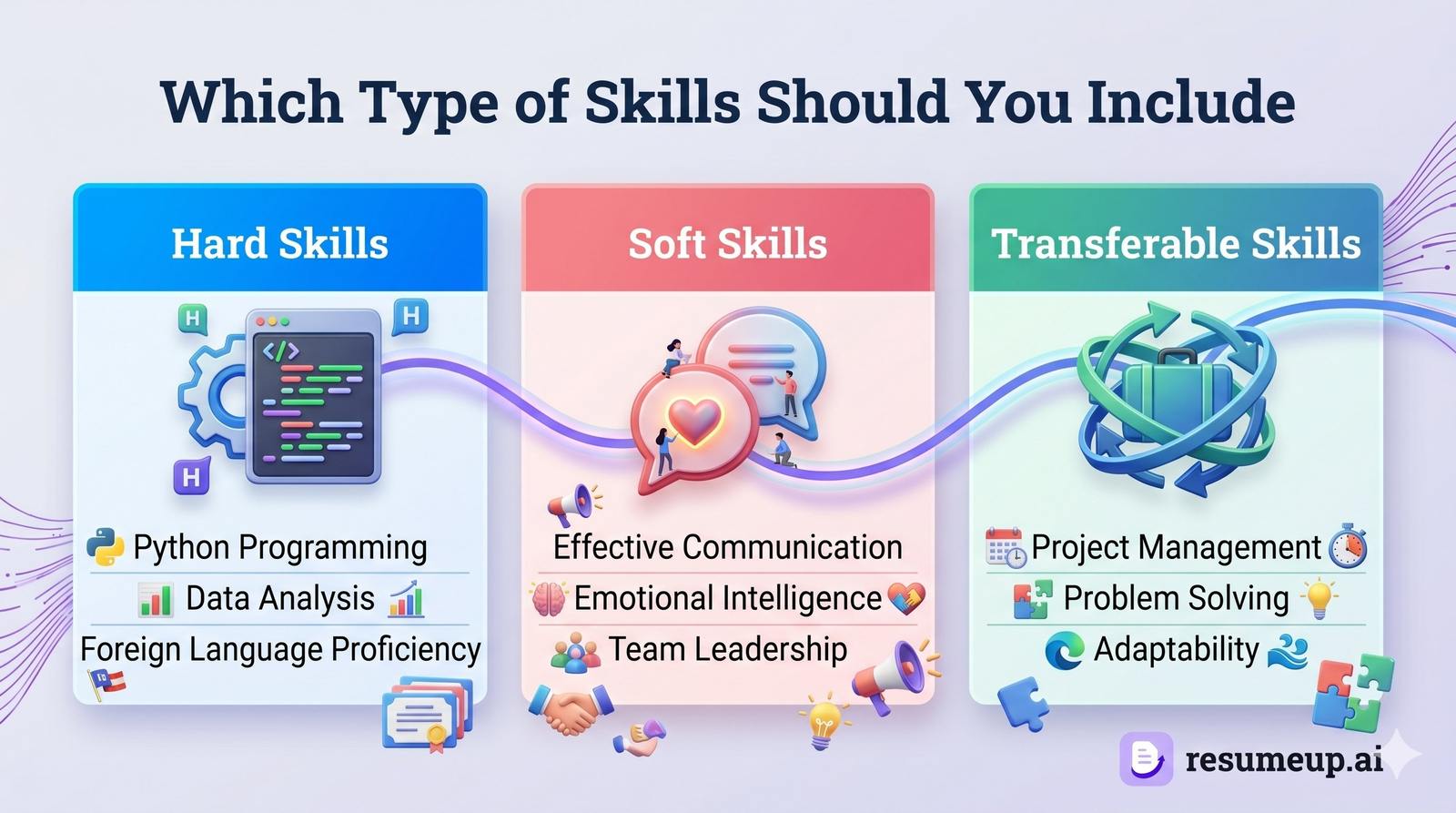
We know why highlighting the right skills is important. But there is still a way to go if you are determined to craft a "perfect" resume. You must be familiar with the category each skill on your resume belongs to, and verify that you haven't over-listed skills from any category. Here's a breakdown of all three.
What are Hard Skills?
Hard skills are skills you develop by training, practice, or experience to perform specific, industry-related tasks. These skills are job-specific and demonstrate the level of proficiency in a particular field. To gain a better understanding of hard skills.
Examples of Hard Skills
Programming: Python, C++, Java
Cybersecurity: penetration testing, network security, forensics
Data analysis: data visualization, database management, big data technologies (AWS, Spark)
Computer skills: MS Word, Excel, and the operating system.
Mathematics: branches of mathematics and their principles.
Software skills: software tools like MySQL and GitLab in the IT sector, SPSS and PACS in the medical sector, Excel and R in the finance sector, etc.
Whatever you list, ensure the hard skills that you've mentioned are relevant to the job description.
What are Soft Skills?
Soft skills are interpersonal skills tied to your behavior and personality traits that enable you to manage work effectively in the workplace. They describe the attributes and habits of the individual that drive both professional and personal growth.
Examples of Soft Skills
Communication skills
Adaptability
Leadership abilities
Time management
Emotional intelligence
Teamwork
Problem-solving
Ethical judgment
Attention to detail
Patience
Conflict resolution
These skills inform the employer about your personality.
What are Transferable Skills?
Transferable skills are skills that aren't tied to one specific job and apply across all kinds of roles. Also called "portable skills," they move with you from any job to any job, regardless of the field.
Examples of Transferable Skills
Project management
Research skills
Customer relationship management
Writing and Editing
Administrative skills
Teamwork
Adaptability
What are the Best Hard Skills to Put on Your Resume by Industry?
Every industry has its demands for hard skills. As the industry changes, so do the hard skills required for that particular industry. Through this section, we aim to explore the hard skills based on industry.
IT and Computer Science Skills
The following technical skills are the hard skills essential in various domains.
Programming
In the programming field, proficiency in programming languages is essential. You can include expertise in programming languages like Python, Java, C++, or other languages based on the job description.
Cloud Computing
Nowadays, every service is offered remotely with the use of the internet using servers. This is cloud computing. Cloud computing is the management, storage, and usage of data over the internet and the delivery of services remotely. Some famous cloud service providers are AWS, Microsoft Azure, and Google Cloud Platform.
Some hard skills to list if you are applying for a cloud-computing-related job are:
Cloud platforms such as AWS, Microsoft Azure, and Google Cloud Platform.
DevOps tools (CI/CD pipelines like GitLab, skills in using tools like Terraform)
Monitoring tools like AWS CloudWatch or Azure Monitor.
Network management
Data storage
Cybersecurity
Cybersecurity experts analyze the security of the systems, identify risks, and troubleshoot problems. They primarily engage in preventing threats from external sources to the data and foreseeing and analyzing any suspicious activity. To obtain a career in the cybersecurity field, one must have the following hard skills:
Programming languages like JavaScript
Risk identification and management
IDS/IPS tools
Cryptography
Penetration testing and vulnerability scanning
Windows and Linux operating systems.
Healthcare Skills
The following skills are required in the healthcare industry.
Nursing Skills
These skills consist of interpersonal abilities that help in assisting and treating the patient with full attention. There are many positions as a nurse. Each position requires a separate set of hard skills. The following is the set of hard skills according to the position of a nursing assistant.
Registered Nurses
RNs are responsible for communicating with the patient's family and spreading awareness of the medical conditions. Skills that should be mentioned on a resume for a registered nurse position are:
Vital signs monitoring
Conducting physical examinations
Detection of abnormalities
Medical administration
ECG machines and other medical equipment.
Nursing assistant skills
A nursing assistant's basic role is to take basic care of patients and provide them with proper care. Some hard skills to be mentioned on a nursing assistant's resume are:
Vital measurements like pressure, pulse, temperature, and respiratory rate
Medical procedures like urinary catheter insertion.
Patient monitoring
Licensed Practical Nurse
An LPN takes care of the patient under the supervision of RNs and doctors. Some hard skills that they can highlight in their resume are:
Certification in Cardiopulmonary Resuscitation (CPR)
Medical equipment like urinary catheter insertion, nasogastric tube management, and oxygen therapy
Patient lifting devices like Hoyer lifts
Medical Coder Skills
A medical coder is a professional who converts the patient's details, lab reports, and any other medical information into universally accepted codes to ensure the accuracy of the data and manage the data effectively. One needs high-value skills to become a medical coder.
ICD/CPT/HCPCS coding
Data entry and management (EHR)
Regulatory and compliance knowledge
MediSoft software
Revenue management coding
Data analysis
Code verification
Healthcare Support
Communication
Basic tests for blood pressure and temperature
Medical procedures
Medical terminology
Emergency response management
Nutrition intake knowledge
Time management capability
Medical Assistance
Medical assistants perform both clinical and administrative duties. Clinical duties include preparing and keeping the prescribed medication ready, preparing the medical instruments for surgery, and assisting with procedures and examinations. Administrative skills include managing medical records, scheduling doctor appointments, and checking patient intake.
EHR management
Sterilization techniques
Vital sign measurement
Awareness of HIPAA
Inventory management
Surgery assistance
Finance and Accounting Skills
Since all the tasks related to finance are performed using various tools nowadays, it is important to be skilled in various tools and also know how to use various software.
Accounting
Budgeting and forecasting
Adherence to GAAP (Generally Accepted Accounting Principles)
Tax preparation and filing
Variance analysis
Verification of bank statements and records
Asset depreciation
Fraud and error prevention talent
Investment Banking Skills
Investment banking deals with helping companies increase their capital. It deals with issuing and selling stocks and serves the company with complex financial needs.
Excel and spreadsheets
Financial system analysis
Borrowed funds acquisition
Capital markets
Quantitative analysis using statistics
Client presentations
Investment proposals
Financial Analysis
Financial analysts are responsible for analyzing the performance of the company regarding finance, decoding the financial metrics, and providing insights on the current market trends.
Some hard skills you can use if you're applying for a financial analyst role:
Financial modeling
Forecasting
Strategic decision-making
Financial software (SAS, FactSet)
ROI analysis
DCF, CCA usage techniques
Marketing and Sales Skills
The following are the hard skills demanded in the sales sector.
Digital Marketing
Search Engine Optimization(SEO)
Affiliate marketing
Web analytics
Conversion Rate Optimization
Content creation
E-Commerce marketing
Sales Skills
Sales forecasting
Presentation
Conflict management
Strategic talent
Market analysis
Cold calling
Product demonstration
Negotiation skills
Customer Service Skills
Problem-solving
Communication
Technical troubleshooting
Feedback managing
Attention to detail
Email correspondence
Complaint handling
Adherence to Service Level Agreements
Engineering Skills
There are various branches of engineering, and each branch deals with different purposes. Hence, each branch has its criteria.
Civil Engineering
Civil engineers perform the construction and design of buildings.
Mathematics and Physics
Computer-aided designs.
Geographic Information Systems (GIS).
Attention to detail.
Structural Analysis and Design.
Hydraulics and hydrology
AutoCAD drafting
Electrical Engineering
Electrical engineers must be proficient in physics, as the major role of electrical engineers is to apply the laws and principles of various branches of physics. They deal with devices that run on electricity, electronics, and electromagnetism.
Circuit design and analysis
Embedded systems
MATLAB
Simulation software
Power systems, analog
Digital Electronics
PCB design, signal processing, and battery systems knowledge
Electromagnetic compatibility
Mechanical Engineering
Since mechanical engineers deal with designing, constructing, and operating machines, they must have profound knowledge of mathematics and physics. They should be aware of engineering principles. Some of the technical skills that a mechanical engineer should possess are:
Computer-Aided Design
Finite Element Analysis
Materials knowledge
Project management
Knowledge of manufacturing processes
HVAC systems
Mechanical testing
HR Skills
When you are applying for a human resources position, ensure you have highlighted the following skills:
Interviewing capability.
ATS management
Communication tools (MS Teams, Zoom, and Google Meet)
Recruitment platforms (LinkedIn, Naukri, and Indeed)
Learning Management System (On-Demand — Skillsoft)
Recruitment marketing
HRIS software (SAP or ADP)
Labor laws
Business Operations Skills
Business operations are the tasks performed by the company in providing its services to the customers or clients. For the management of business operations, we need the following skills:
Budgeting and forecasting
Technology integration
Analyzing
Performance metrics
Inventory management
Quality assurance
Workflow automation tools (Zapier, HubSpot)
Contract management abilities
Web Development Work Skills
Server Skills
Languages like Node.js, PHP, Java, etc.
Frameworks like Django (Python), Express.js (Node.js), etc.
CI/CD pipelines
Version control software like Git
Command-line interface
Knowledge of web security policies and strategies
Cloud Computing & Cloud Engineer Skills
Cloud platforms like AWS and Google Cloud.
DevOps tools (Ansible, Puppet).
API management
System design
serverless infrastructure
Cloud architecture
Monitoring and logging
Content Writer Skills
Search engine optimization.
Research
Writing tools and software (Google Docs, MS Word)
Proofreading
Data analysis and multimedia
Keyword research
Business-to-business and business-to-consumer writing
Social media management
Art and Design Skills
UX/UI Design
Design tools (Adobe Photoshop, Sketch, and Figma)
Interaction design abilities.
Wireframing and prototyping
Front-end development.
Usability testing
Animation and motion design
Remote user testing
Graphic Design
Ideation techniques
UI/UX design
Typography
Software (Adobe Photoshop and InDesign)
Color theory
Visual storytelling
Photo and video editing
Skills for Data Analysis
Data wrangling and cleaning.
Analysis tools like R
Visualization tools (Tableau)
Application Programming Interface management.
Cloud computing
ETL processes (Extract, Transform, and Load)
API integration
BI software
Presentation Skills for Resume
You can also highlight your presentation skills if required. Some jobs, like sales executive roles and consultant roles, need these presentation skills. In such cases, where required, you have to demonstrate your presentation skills so that the recruiter will know that you are capable of handling the connections well.
Audience engagement techniques
Storytelling
Public speaking
PowerPoint
Multimedia integration
Visual communication
Slide-deck management
Negotiation Skills Resume
In cases where agreements matter, negotiation skills play a vital role.
Deal closure techniques.
Client negotiation techniques.
Cross-functional collaboration.
Vendor management.
Time Management Skills
Time management skills are very important, irrespective of the sector that you are working in. These skills include creating a timetable, avoiding procrastination, setting a timer, following the timer properly, keeping track of the time, etc.
Server Skills for Resume
Languages (Node.js, PHP, Java)
Frameworks(Django (Python), Express.js (Node.js))
CI/CD pipelines
Database management (Oracle, SQL)
Backup and recovery
Scripting and automation
Hardware maintenance
Warehouse Skills for Resume
Warehouse management handles the supply of goods, the storage of goods, and the management of goods in the warehouse.
Inventory management
Shipping and dropping
Warehouse management systems
Logistic coordination
Monitoring
Stock replenishment
Pallet jacks
Retail Skills for Resume
Customer Relationship Management (CRM) system.
Product knowledge
Retail management software like ERP.
E-commerce platforms
Sales analytics.
Point of Sale systems.
Retail operations from opening to closing
Prevention of loss
Management of the reduction in theft
Reporting on sales
Office Skills for Resume
Whatever the job is, you will have to work in the office. Some of the common skills to finish the office work smoothly are:
Data entry
Time management skill
Excel, PowerPoint, cloud services
Use of office common equipment
Team collaboration
Management of workflow
Basic troubleshooting
Legal Resume Skills
Wondering what these "legal resume skills" are? These skills are those that involve handling legal procedures.
Writing:
For any legal document, you have to write. You can showcase this skill as follows:
Expertise in highly valuable contract writing that assures the client's success.
Legal procedures.
Research
Research in case laws
Command on legal drafting
Trial preparation strategies
Court filings
Education Skills
Usage of e-learning platforms.
Learning management systems like Google Classroom.
Educational research tools
Survey tools like SPSS and Google Forms.
Data analysis and reporting
Group facilitation capability
Assessment and evaluation
Educational planning management
Parent communication
Curriculum development
Receptionist Skills and Abilities for a Resume
A receptionist needs to have high-level communication skills and the ability to answer the customer's questions regarding the company.
Communication
Organization schedules
Data entry
Software tools like Excel.
Positive and friendly tone with customers
Multi-tasking
Receptionist duties and responsibilities
Record maintenance (physical and digital)
Product Manager Skills for a Resume
A product manager, as the name suggests, is a qualified person who is competent in analyzing the market, plotting a roadmap for the development of a product, and taking responsibility for the success of the product. Product management requires hard skills like:
UX design
Product development lifecycle
Modern technologies
Sketch and Figma
Data analysis
Data visualization
Product Marketing
Stakeholder management
Cross-functional collaboration
Product launch
Skills for a Resume for Teachers
Teachers play a major role in shaping the future of students. It is highly necessary that the teachers are trained well enough, have adequate knowledge of the subject, and are highly skilled in delivering comprehensible lectures. If you are aspiring to become a teacher, the following skills help in making your resume stand out.
Classroom management
Communication and public speaking
Computer skills for storing the data of students
Knowledge of the particular subject
Certifications in the subject field
Problem-solving
Assessment and evaluation
Resume Skills for Beginners
For a beginner, the skills to be updated in a resume depend on their academic background and the career or job that they want to pursue. The mentioned skills and projects should align with their academic wins and the specific job as well. An effective resume showcasing the skills in demand shows that the candidate is interested and prepared for the job. For freshmen, the skills depend on the sector.
Here's a quick snapshot of skills for freshers in various domains:
Data Scientist skills in a resume for freshers
Machine learning
Tableau
Programming languages
Data design
Data manipulation
Optimization techniques
Data ethics
Algorithm evaluation
Data science projects
Digital marketing skills in a resume for freshers
Customer Relationship Management
Creativity
Video creation and publicity
Social media marketing tools
Link-building
UI/UX principles
Content management software like WordPress
Video and affiliate marketing
Cybersecurity skills for freshers
Penetration testing
Malware analysis
Security policies
Suspicious activity detection
Coding knowledge
Risk management
Database security
Forensics
Security tools
Ethical hacking
Software engineer skills for freshers
Programming languages
Software development
Quality control
Quality assurance procedures
Latest software and technologies
Debugging
Operating systems
Machine learning
Current technology trends
Medical officer
Medicinal procedures
Medical tests
Medical equipment
Pharmaceutical knowledge
Diagnostic imaging
Lab reports and medical reports
Ensuring patient safety
ACLS and BLS certifications
HR department
Assessing and evaluating
Recruitment processes
Confidentiality
Decision-making
Employee relations
HR procedures and policies
Current job market trends
Project management
Which Soft Skills Should You Highlight on a Resume?
The soft skills worth highlighting are communication, leadership, problem-solving, adaptability, and organization — the interpersonal abilities that show an employer how you work, not just what you can do.
Don't put all your eggs in one basket. Listing hard skills for the specific job is not sufficient to help you pass through the first step. The common blunder that is performed by many aspirants is believing that hard skills are all that are looked for by the employer or overlisting soft skills and neglecting the technical ones.
Any job requires both technical and interpersonal skills to fulfill it. It takes more than just hard skills to decide whether you are fit for the role or not. Therefore, it is beneficial to check if you have listed both hard skills and soft skills on your resume and also examine whether the skills align with the job description or not.
Here are the soft skills that matter most:
Communication and Interpersonal Skills
You are probably aware of how crucial communication skills are at any period of life. Be it job or personal circumstances, communication is the key. When you can communicate your thoughts effectively, it allows the team members to grasp a clear idea of the work and their roles. It promotes efficiency in the outcomes and enhances teamwork.
Through your communication, you can build and maintain positive relationships with the team members that create a friendly environment at the workplace. There might be mismatches in people's thoughts, and misunderstandings might arise that will pave the way to conflicts. But to resolve such conflicts, you can always interact and communicate with the people.
Not only personal interactions and environment, but also communication play a major role in creating a lasting impression on the customer. Communication abilities help the customer to address their demands and needs properly, which can help the work to satisfy the customer. It allows the customer to bring forward his or her feedback without any hesitation. By communicating, you can also gain the trust of the customer, which is essential in any case.
Without customer cooperation, your hard work will be in vain. So put your cards on the table. Now you have understood the significance of communication in the workplace. By now, it is clear that communication is one of the most vital soft skills that is most appreciated by recruiters.
Leadership and Management Skills
Following communication, leadership is also an important factor in determining your behavioral abilities. Leadership qualities include decision-making abilities, the ability to guide the team and provide mentorship, and accountability for all tasks.
Decision-making
Mentoring and tutoring abilities
Accountability
Task management and scheduling
Innovation
Crisis management
Duty and work assignment
Feedback delivery
Here we provide you with some examples of demonstrating leadership and management skills in your resume:
Proficient in task management and served 4+ years as a team leader.
Highly experienced in guiding teammates to foster the development of the organization. Spearheaded a prestigious event involving many dignitaries, showcasing robust management and leadership abilities.
Problem-solving and critical thinking
Mastery is meaningless if it cannot solve a puzzle. You have the right skills needed for the job, but if you cannot use the skills and frame a solution to a specific problem, then what is the use of the skills? So problem-solving and critical thinking are also important soft skills that you can put on your resume.
Examples of problem-solving skills in different scenarios are:
Scenario:
A customer is dissatisfied with the product and is willing to provide negative feedback.
Skill: Listened to the concerns of the customer and assured a refund or an exchange in return, offered limited discounts on future products, thus avoiding damage to reputation and also satisfying the customer with apologies.
Scenario:
A software application is causing trouble by executing in an unwanted way.
Skill: Analyzed the code for errors, troubleshot and fixed the bugs, and ensured the coding and the software management were done accurately. Resolved the issue, and now the applications work in our favor.
Scenario:
The number of users for the network is reduced due to glitches and improper working.
Skill: Fixed the network issues and offered high discounts on recharge purchases. Enabled many exciting offers and facilities, thus compensating for the loss of the network
Adaptability and Flexibility
Adaptability and flexibility are also crucial qualities for any job aspirant. Irrespective of the job sector, these skills are mandatory. Adaptability means being able to adjust to new environments quickly and get along with the new experiences without affecting work performance.
Flexibility means being available anytime regarding work issues or anything. Flexible means you can easily adjust to your behavior and the changing circumstances. Both in personal and professional life, these skills are important because, in this fast-paced world, situations keep changing from second to second.
At the workplace, behaviors in fellow workers or the department you are working in keep changing rapidly, and you should be able to pass through the changes and deliver the same positive work performance.
Organizational Skills
Organizational skills are those skills that help you manage and finish the tasks properly. They include time management, scheduling and implementing skills, proper planning, prioritization techniques, goal setting, project management skills, resource management, and many more common skills that you must have to organize and properly execute a plan regarding work.
What If the Company Doesn't Use ATS?
Even if a company doesn't use an ATS, you still need to list the right skills because a human recruiter reads your resume, and they lean on the skills section just as heavily to judge your fit, fast.
When there's no software doing the filtering, a recruiter goes through resumes themselves. But a person can't carefully read hundreds of resumes in a single day, so they skim.
According to a 2018 Ladders eye-tracking study, recruiters spend an average of just 7.4 seconds on their initial scan of a resume. In those few seconds, a skills section filled with the abilities the role actually needs gives them a reason to keep reading, and the right skills are what make the final decision that you are right for the role.
So, whether it's an ATS screening test or a human analyzing your resume, the conclusion is the same: listing the right, job-specific skills is important to getting past the first scan.
How Do You Tailor Your Resume Skills to a Specific Job?
You tailor your resume skills by reading the job posting, matching keywords to the job description, prioritizing the most relevant ones, and backing them up with quantified results.
Your resume reads as if it were built for that exact role, which is achieved by using strong action verbs and the right keywords. Here are the steps to follow:
Ensure the skills match
Check if the job description aligns with the current skills you have mastered.
Prioritize
Highlight the most relevant skills first. Focus on only relevant skills. Listing irrelevant skills will lower your chances of getting shortlisted.
Quantify
When mentioning achievements at your previous workplace, it is recommended to quantify the achievements.
Using keywords
Try to use as many keywords as you can that are present in the job description because ATS will scan for the keywords, and the keywords are their main basis for shortlisting a resume.
Certifications and projects
Include the certificates in the relevant skills if you have any, and also describe the projects in a related field that you have worked on.
Keep it current
Every time you apply for a job, ensure your resume is updated and up-to-date with the latest technologies.
Still not sure how to tailor yours? Here's an example
Tailored Resume
Job description
We are looking for a skilled data analyst with strong expertise in SQL and experience working with AWS native services, Talend, MySQL, and PostgreSQL. Develop and maintain data integration processes using Talend, ensuring seamless data flow across multiple sources. Create and maintain reports and dashboards to visualize data using tools like Tableau, Power BI, or similar. Experience with Snowflake for data warehousing and analytics. Assist in the design and implementation of data warehousing solutions, supporting business intelligence initiatives.
Professional Summary
Highly proficient in SQL with 5+ years of experience working with AWS services, especially Talend. Well-versed in the maintenance of dashboards and in-depth knowledge of data visualization. Established skills in the implementation of data warehousing solutions. Demonstrated successful projects on data analysis using Talend and Power BI.
Key skills
Expertise in using SQL software
Experience in AWS services
Proficient in using Talend and MySQL
Data visualization tools (Tableau, Power BI)
Data warehousing and analytics (Snowflake)
Professional experience
Carried out many successful projects on data analysis using tools like Power BI.
Used SQL for data analysis to enhance accuracy.
Assisted in designing and implementing data warehousing solutions using Snowflake.
What are the Best Practices for Listing Skills on a Resume?
The best practices for listing skills are to place them in the right section, group them by type, quantify them with results, and weave them into your work experience; these make your skills easier for a recruiter to spot. Here's how to do each.
Skill Section Placement
Based on the number of skills you want to list and the type of skills you want to list, you can choose any of the following skills sections: technical skills section, additional skills section, and relevant skills section.
Technical skills section
If the job you are applying for seems to equally prioritize skill set and work experience, then opting for technical skills is good.
Example: cybersecurity resume (only skills section)
Malware analysis
Linux operating system
Security frameworks and standards
Wireshark.
This section can be used in the resumes of candidates who have years of experience in the industry.
Additional section
This is a section where you will list only a few skills, and this section is integrated with other skill sections. In general, if you decide to list your skills in an additional section, then work experience will take up most of the space in the resume. This is often linked to the technical skills section.
An additional skills section might look like this:
Communication
Problem-solving
Critical thinking
Relevant skills
In case you feel your previous work experience demonstrates a lot more than your skill set would demonstrate, then you can go for this relevant skills section. This section lists your skill set as one headline, your work experience as one, and your achievements as one. You can also include interpersonal skills.
Example
Skills
Programming languages
Database management system
Proficiency in software like SQL and Oracle
Experience
Worked as one of the successful trainers in the programming language Java
Senior database administrator with 2+ years of experience
Led the team and worked on successful projects of the company to make a significant contribution. Accuracy and data management statistics turned out at positive rates.
Achievements
Awarded was the most dedicated employee of the year in recent years.
Recognized for making significant contributions towards the success of the organization.
Appreciated and endorsed by many dignitaries in the field for excellence in problem-solving and decision-making.
Interpersonal skills
Communication skills
Conflict resolution
Adaptability
Flexibility
Time management
Demonstrating Skill Proficiency
You can showcase your skills in your work experience to make a positive impression on the employer. Combining your work experience with skill demonstrations is a good practice to stress your competence for the role. It repeatedly keeps informing the employer that you are fit for the role. You can even mention the level of expertise you have in a particular skill to clarify your learning level. There is a cover letter for every resume for a more personalized illustration of your skills. It is also recommended to highlight your competencies in a way more personalized manner in your cover letter.
Quantifying Your Skills
When talking about achievements or the contributions you have made to your workplace, you can quantify your achievements. Like,
Increased sales rates by 15%
Produced 70% more efficiency in the algorithm
Coming to skills, you can mention your skills by quantifying them. An example is as follows:
Worked on 5+ successful projects in data analysis
Implemented and executed 7+ algorithms for the problem
Verified 60+ datasets for carrying forward the skills
Skills in the Work Experience Description
As already discussed, it is advised to include your skills even in your work experience description. Integrating the work experience with the skills is one of the ways to continuously stress your achievements and competency.
How Can You Build Skills to Add to Your Resume?
It's one thing to list the skills, but what's the backstory behind acquiring those skills? Success is visible, but the journey is often hidden. What's in the journey for you? How do you start your journey?
Let us answer all the questions above. In simpler terms, how do you gain the skills that are required to get the job? The Internet is a free school. We have no place to complain about the lack of resources. The answer to every question is the internet itself. By utilizing the internet properly, you can acquire skills or gain knowledge in any field. Here's how:
Through online certification courses and online tutoring
You can visit a lot of websites to gain a deeper understanding of a single topic.
You can volunteer in various programs and attend workshops by professionals.
Attend conferences and engage in discussions related to your field.
Arranging a personal mentor for you to give guidance in your journey.
Do internships to get hands-on experience.
Frequently asked questions
What are the Best Skills to List on Your Resume?
There is no such thing as the best skill, but the best practice would be to list the skills that are most relevant to the job description. Also, listing both hard skills and soft skills is crucial.
What is the Correct Number of Skills on My Resume?
A considerable number would be from 5 to 10. It is not recommended to list more than 10 skills, as excess in anything leads to downfall. Tailor your skills to the job description and mention an adequate number of hard and soft skills.
Can I List Soft Skills on My Resume?
Yes, you must include soft skills on your resume because they help in performing the work effectively and managing everything without any obstacles. Listing soft skills is important to showcase how well you can carry forward the work. Examples are adaptability, time management, and leadership abilities.
How Do I Tailor My Skills to the Job Description?
Review the job description carefully and prioritize the most relevant skills. Mention keywords that are also present in the job description. Ensure to be on par with modern technologies.
How Do I Format My Skills on My Resume?
Find the relevant skill and prepare a proper headline. Then use the necessary keywords. Categorize the skills into sections. Use bullet points to make it look organized. Give a brief description of the skills. Avoid overwriting.
Is it Okay to Include Skills I Learned Outside of Work?
Yes, it is okay to include skills you learned outside of work, especially if the specific skill matches the job description. But if the skill is not related to the role, it is meaningless to list it since it does not add any value to the resume. Avoid overloading and prioritize the skills based on their relevance.

Rohith Reddy
Co-Founder
Rohith co-founded ResumeUp.AI after a decade building software and hiring engineers. He graduated from IIIT in Computer Science, then worked at ADP, YuppTV, and Paperguide — leading teams and conducting 500+ technical interviews as a hiring manager. He writes from both sides of the table: what recruiters actually look for, and what the candidate side of the resume actually feels like.