All Blogs
Sprout AI Job Search Review (2026): I Tested the App for a Week
I tested Sprout for a week in 2026: job matching, resume import, and what's behind the paywall. Here's what works, what doesn't, and the alternative I'd pick.

I kept running into Sprout while looking for job tools. It's all there over the social media platforms like TikTok and Instagram. The pitch landed: I was tired of typing the same details into form after form, and having something else to do, it sounded like getting my evenings back. And it's not like this is a one-time problem. Median US job tenure has fallen to 3.9 years, the lowest since 2002, per the BLS, so most of us will run this search again and again.
But that only helps if the applications go out with your name on them. I wanted to see if they were, so I signed up in July 2026, uploaded my resume, and let it find and send applications for me. Here’s what works, what doesn’t, and what I’d pick instead.
How I Reviewed Sprout: I signed up in July 2026 and tested Sprout with my own resume. I checked what carried across on import, searched jobs in my own field, and used the apply flow. Quick Apply needs a paid plan, so for that part I read App Store reviews and Reddit threads from people who had paid.
Transparency: ResumeUp.AI is our own product. This review is based on hands-on testing of Sprout in July 2026, and I've tried to give a fair, honest comparison, including where Sprout does things well.
TL;DR
Sprout finds jobs and fills in the applications for you. It matches roles by title, location, and distance, writes the application, and waits for your approval before anything goes out.
Where it falls short: the AI writing sits behind a subscription, so you pay before seeing what goes out with your name on it. There's no ATS score against the job you're targeting, matching gets shakier outside common roles, and every plan has the same features, so more money only buys more applications.
Best for: people whose main bottleneck is the time applying takes, and who are applying to mainstream roles where the matching works well.
ResumeUp.AI is the best alternative if you're already applying plenty and hearing nothing back. It scores your resume against the exact job, shows the keywords you're missing, and includes 20+ templates, a LinkedIn optimizer, and mock interviews for $8.25 a month annually.
Quick Comparison: Sprout vs ResumeUp.AI
Feature | Sprout | ResumeUp.AI |
Best for | Sending a high volume of applications | Tailoring each application to the job |
Price | $19.99–$79.99/mo | $29/mo, or $8.25/mo annual |
Free AI access | ❌ Subscription model | ✅ 20 free AI credits |
Application limits | ⚠️ 80-600 a month by plan | ✅ No cap |
Job matching | ✅ | ✅ |
Resume templates | ❌ | ✅ 20+ with full customization |
ATS score vs exact job | ❌ | ✅ Scored against the job you paste |
Keyword level report | ❌ | ✅ Missing keywords + usage counts |
AI cover letters | ✅ | ✅ |
Cover letter checker | ❌ | ✅ |
LinkedIn optimizer | ❌ | ✅ |
Mock interviews | ❌ | ✅ |
Job tracker | ✅ | ✅ |
Auto-fill applications | ✅ Quick Apply | ✅ Chrome Extension |
Verified July 30, 2026, from Sprout's product pages, App Store reviews, and hands-on testing. Features shift, so we recheck quarterly.
Also checkout:
What is Sprout? Full Breakdown
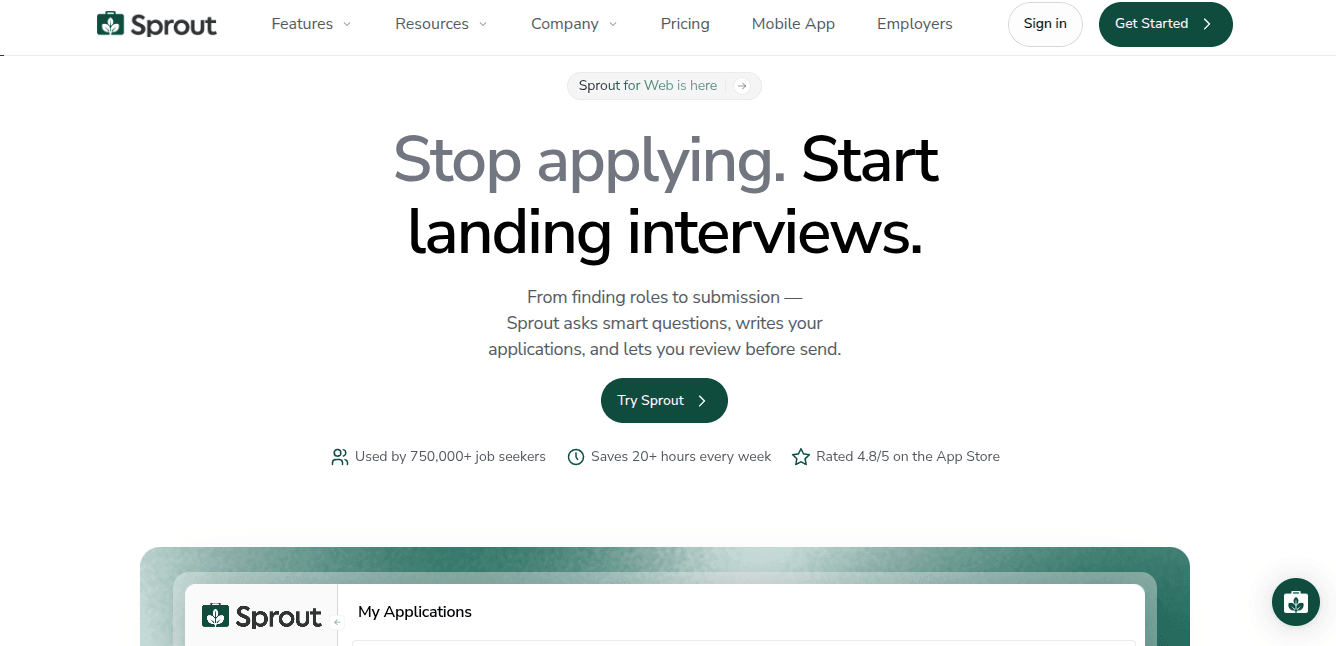
Sprout’s promise is simple: stop applying, start landing interviews. Job hunting has moved online. 79% of job seekers use online resources, and half of mobile job seekers now apply straight from their phones, per Pew Research Center. That's the behavior Sprout is built around.
It finds jobs that fit your background, asks you a few questions, fills in the applications for you, and lets you check each one before it goes out. No typing the same details into form after form, and no losing a whole evening to five applications.
You upload your resume, tell it what role and location you want, and Sprout starts showing you matches. From there you can apply in one click, paste in a job you found on your own, and keep track of everything in one place. It also handles the emails that come back.
Features
AI job matching by role, location, and distance
Quick Apply to send an application in one click
Applications filled in for you, with a review step before sending
Import job to apply to a posting you found
Built-in job board filters and a describe-your-search option
Application tracker to see everything you’ve sent
Email handling for replies that come back
Mobile app for job searching on the go
What Makes It Stand Out
You approve every application. Sprout fills things in but waits for your review before sending, so nothing goes out with your name on it that you haven’t seen.
One click to apply. Quick Apply removes the repetitive form filling that makes applying exhausting.
Bring your own jobs. Import jobs let you use Sprout on a posting you found elsewhere, not just the ones it surfaces.
Everything in one place. Matches, applications you’ve sent, ones you skipped, and the emails that come back all live in the same dashboard.
Where It Falls Short
Matching depends on your field. Common roles return relevant results, but searches in other fields can bring back jobs from unrelated industries and levels that were never asked for.
You pay before you see the writing. Quick Apply and the AI-written applications sit behind a subscription, so there’s no way to check the quality of what goes out until you pay.
You’re buying volume, not better tools. Every plan has the same features. More money only gets you more applications, not a better one.
Weekly billing costs far more. Basic at $9.99 a week is about $40 a month against $19.99 on the monthly plan.
Uninstalling doesn’t cancel your subscription. Deleting the app leaves the subscription running, so charges keep coming.
Applications can stall on extra questions. Applying can be held up until you answer Sprout’s follow-up questions, so one click isn’t always one click.
How Much Does Sprout Cost?
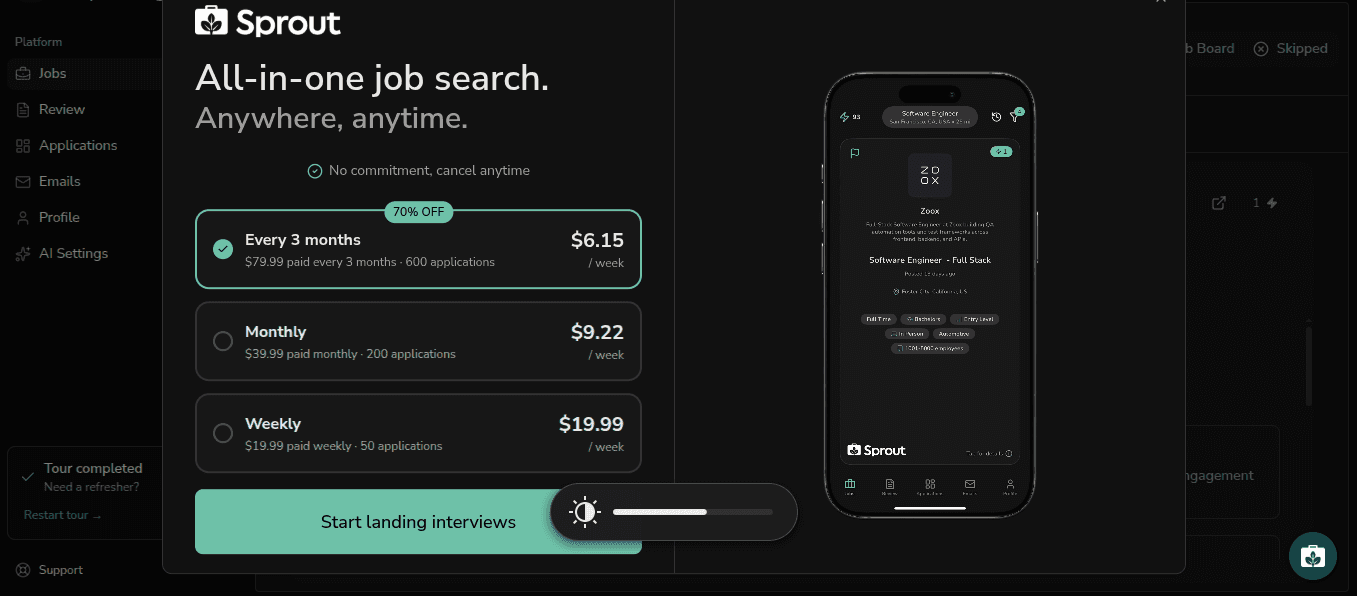
Sprout has three plans, and you can pay weekly or monthly. Every plan includes the same features: end-to-end application with review, tailored cover letters, resume tailoring for each role, application tracking, real-time updates, and mobile and web access. The only thing that changes is how many applications you get.
Plan | Weekly | Monthly | Applications |
Basic | $9.99 | $19.99 | 20/week or 80/month |
Pro | $19.99 | $39.99 | 50/week or 200/month |
Ultra | $29.99 | $79.99 | 150/week or 600/month |
Two things worth knowing. Paying weekly costs a lot more: Basic at $9.99 a week is about $40 a month, against $19.99 on the monthly plan. And since every plan has the same features, you’re applying for volume, not for better tools.
My Sprout Test (July 2026): What Actually Happened
Setting Up and Uploading My Resume
Signing up was quick. I created an account, uploaded my existing resume, and Sprout pulled almost everything across correctly: summary, experience, projects, education, awards, and all 24 skills and certifications landed in the right places, with a guided tour to set up.
The only issue was where things ended up. A few of my achievement bullets got filed under Additional instead of Achievements. Nothing was lost, just placed in the wrong spot, and it takes a minute to move them.

The Job Matches
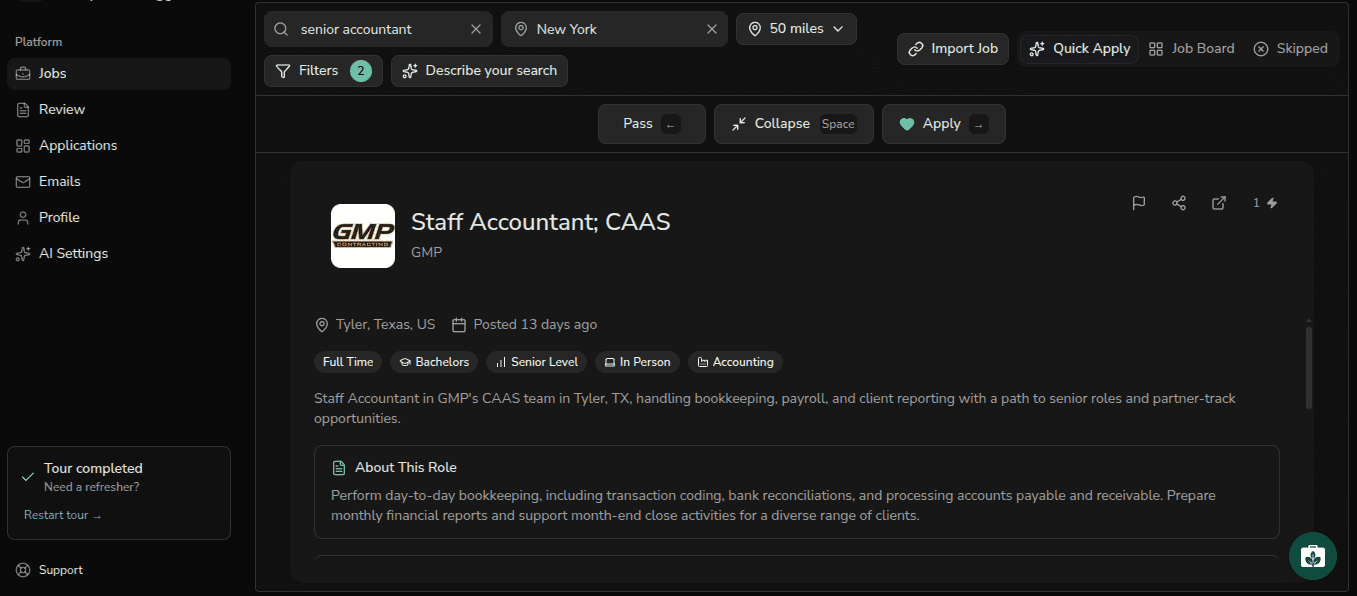
Sprout shows you one job at a time, and you can pass or apply with a single key. You can filter by role, location, and distance, import a job you found somewhere else, or browse its job board.
The matching worked well. When I searched “senior accountant,” it gave me accounting roles across the board, including Staff Accountant and Audit Senior jobs, all in my field and in the area I picked. A few were a level below what I searched for, but nothing was random.
That’s the main thing you want from a tool like this: jobs you’d actually think about applying to, instead of a list you have to dig through.
Applying
Applying looks simple. Each match has an Apply button with a keyboard shortcut, and Quick Apply is there for sending one in a single step. Sprout fills in the application, and you check it before it goes out.
That review step is the right idea. Nothing gets sent under your name without you seeing it first, which is more control than the fully automatic tools give you. But I couldn’t get that far. Quick Apply needs a subscription, so the flow stops at upgrade. You have to pay before you can see a single application Sprout would send for you.
My Takeaway from the Test
Sprout gets the basics right. Sign-up was fast, my resume imported cleanly with only a small filing slip, and the job matches were genuinely relevant to my field, which is more than a lot of these tools manage.
But the part that decides whether any of it works is the part you can't see. The resumes and cover letters Sprout writes for you sit behind a subscription, so you're paying before you know what goes out with your name on it.
Sprout Ratings & User Reviews
On the App Store, Sprout holds 4.6 out of 5, with users crediting the swipe-to-apply flow and the time it saves on filling in forms.
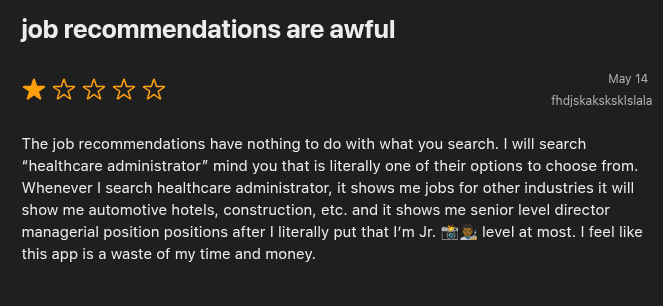
The complaints center on job matching. Users report searches returning roles from other industries and levels far above what they set.
What Customers are Saying
A 1-star reviewer says searching "healthcare administrator" returned automotive, hotel, and construction jobs, plus senior director roles despite setting a junior level.
A 2-star reviewer likes how easy it is to apply by swiping, but says the job titles in their field don't come up at all, and that applications get delayed unless you answer Sprout's extra questions.

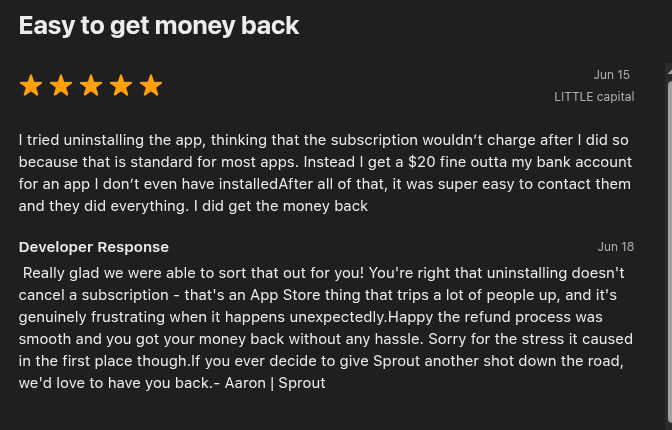
A 5-star reviewer was charged after uninstalling the app, then got a full refund. Sprout's reply explains that uninstalling doesn't cancel an App Store subscription, and apologizes for the trouble.
A Reddit user credits Sprout with tracking what they'd actually applied to after 50 targeted applications got no responses, calling it useful for the "am I even being seen" question.

What’s the Best Alternative to Sprout?
The best alternative to Sprout is ResumeUp.AI. It keeps what Sprout gets right: job matching, cover letters, and a tracker for everything you’ve sent. What changes is what you’re paying for.
Sprout sells you applications. The more you pay, the more you send. ResumeUp.AI works on the other end of the problem: its ATS checker scores your resume against the exact job you paste in, shows which keywords you’re missing and how often you use the ones that matter, then fixes the gaps in one click. That’s the step that decides whether a person ever sees your application, no matter how many you send.
And it covers the whole search, not just the resume:
ATS checker that scores against the exact role
You can also try the AI before you pay, with 20 credits, so you can see the quality of what it writes first. One plan is $8.25 a month billed annually ($29 monthly), with no per-application limits.
Sprout vs ResumeUp.AI: Where They Differ
Applying to Jobs: More Volume vs Better Fit
Sprout wins on speed and reach. It finds the jobs, fills the applications, and lets you approve each one before it goes, so you can get through more in an evening than you could by hand.
ResumeUp.AI wins on what actually goes out. Its Chrome Extension autofills applications on LinkedIn, Workday, Greenhouse, and more, so applying is still fast, but each resume is matched to the job first. Sending 600 generic applications and sending 60 tailored ones are different, and only one of them gets stronger the more competitive the role.
Recruiters spend an average of 7.4 seconds scanning a resume on the first pass, according to Ladders. What wins in that window is a resume that surfaces the right things fast, not a bigger pile of the same one.
ATS Scoring: No Score vs Job-Specific
ResumeUp.AI wins, and it’s not close. It scores your resume against the exact job you paste in, shows every keyword you’re missing, counts how often you use the important ones, and fixes the gaps in one click.
Sprout doesn’t score at all. It tailors your resume for each role, but it never tells you how that resume stacks up against the posting, so you’re sending applications without knowing what the filter sees.
Trying Before You Pay: Paywall vs Free Credits
ResumeUp.AI wins. You get 20 free AI credits, so you can see the quality of what it writes before you spend anything. Sprout puts its AI behind a subscription. Quick Apply and the written applications need a paid plan, which means paying first and finding out second.
Pricing: Paying Per Application vs One Plan
ResumeUp.AI wins on value. One plan at $8.25/mo on annual billing covers everything, with no cap on how many jobs you tailor for. That’s about 59% less than Sprout’s cheapest plan, 79% less than Pro, and 90% less than Ultra.
Sprout charges by volume, from $19.99 to $79.99 a month, and every plan has the same features, so paying more doesn’t get you a better application. Weekly billing costs the most: Basic at $9.99 a week sounds cheap, but four weeks of it costs $40, while the monthly plan gives you a similar number of applications for $19.99.
Which Should You Choose?
Choose Sprout If
You want something else to fill in the applications so you stop losing evenings to forms.
You're applying to common roles where the matching works well
You want to send a lot of applications quickly, but still approve each one
You'd rather search and apply from your phone
You're fine paying before you can see what the AI writes
Choose ResumeUp.AI If
You want your resume scored against the exact job you're applying to
You're going for senior, technical, or specialized roles that need the right keywords
You'd rather send fewer, stronger applications than more of the same one
You want to try the AI free before you pay
You need the full kit: resume builder, LinkedIn optimizer, cover letter checker, mock interviews, and autofill.
You want one plan with no limit on how many jobs you apply for
If the thing slowing you down is the time it takes to fill in forms, Sprout solves that. But if you're sending applications and hearing nothing back, more of them won't fix it. ResumeUp.AI works on the reason they're not landing, which is what decides whether anyone sees your resume in the first place.
Frequently Asked Questions
How much does Sprout cost?
Sprout has three plans: Basic at $19.99 a month, Pro at $39.99, and Ultra at $79.99. You can also pay weekly, from $9.99 to $29.99, but that works out much more expensive over a month. Every plan includes the same features. The only difference is how many applications you get, from 80 a month up to 600.
Is Sprout legit?
Yes, Sprout is a real tool with a 4.6 rating on the App Store. It replies to negative reviews and issues refunds when people are charged by mistake. The complaints are about job matches in some fields and unexpected charges, not about the company taking money and disappearing. Worth checking, given that reported losses to job scams hit $501 million in 2024 per the FTC, but Sprout isn't one of them.
How does Sprout work?
You upload your resume, set the role and location you want, and Sprout starts showing you matching jobs one at a time. You can pass or apply with a single key. When you apply, Sprout fills in the application and tailors your resume for that role, then lets you check it before it goes out. It also tracks everything you’ve sent and handles the replies.
Does Sprout apply to jobs automatically?
Not without you. Sprout writes the application, but it waits for your approval before sending, so nothing goes out under the name that you haven't seen. That's more control than fully automatic tools give you, but it also means you still have to sit down and review.
What’s the best alternative to Sprout?
ResumeUp.AI is the best alternative for most job seekers. Instead of selling you applications by volume, it scores your resume against the exact job you paste in, shows the keywords you're missing, and fixes the gaps in one click. You also get 20+ templates, a LinkedIn optimizer, a cover letter checker, mock interviews, and autofill for $8.25 a month, billed annually.

Rohith Reddy
Co-Founder
Rohith Reddy is the co-founder of ResumeUp.AI and a former hiring manager who conducted 500+ technical interviews over a decade at companies including ADP. His hiring-market research at ResumeUp — including studies on ghost jobs and AI's impact on entry-level hiring — has been covered by Entrepreneur. A Computer Science graduate, he writes about what recruiters and ATS systems actually reward, from both sides of the hiring table.