AI Slashes Entry-Level Job Market by Over 50% for Gen Z, Study Finds
ResumeUp.AI tracked 8 AI-exposed job categories from Q1 2023 to Q2 2026. Entry-level openings remain 52% below 2023 levels - software engineering is down 66%.
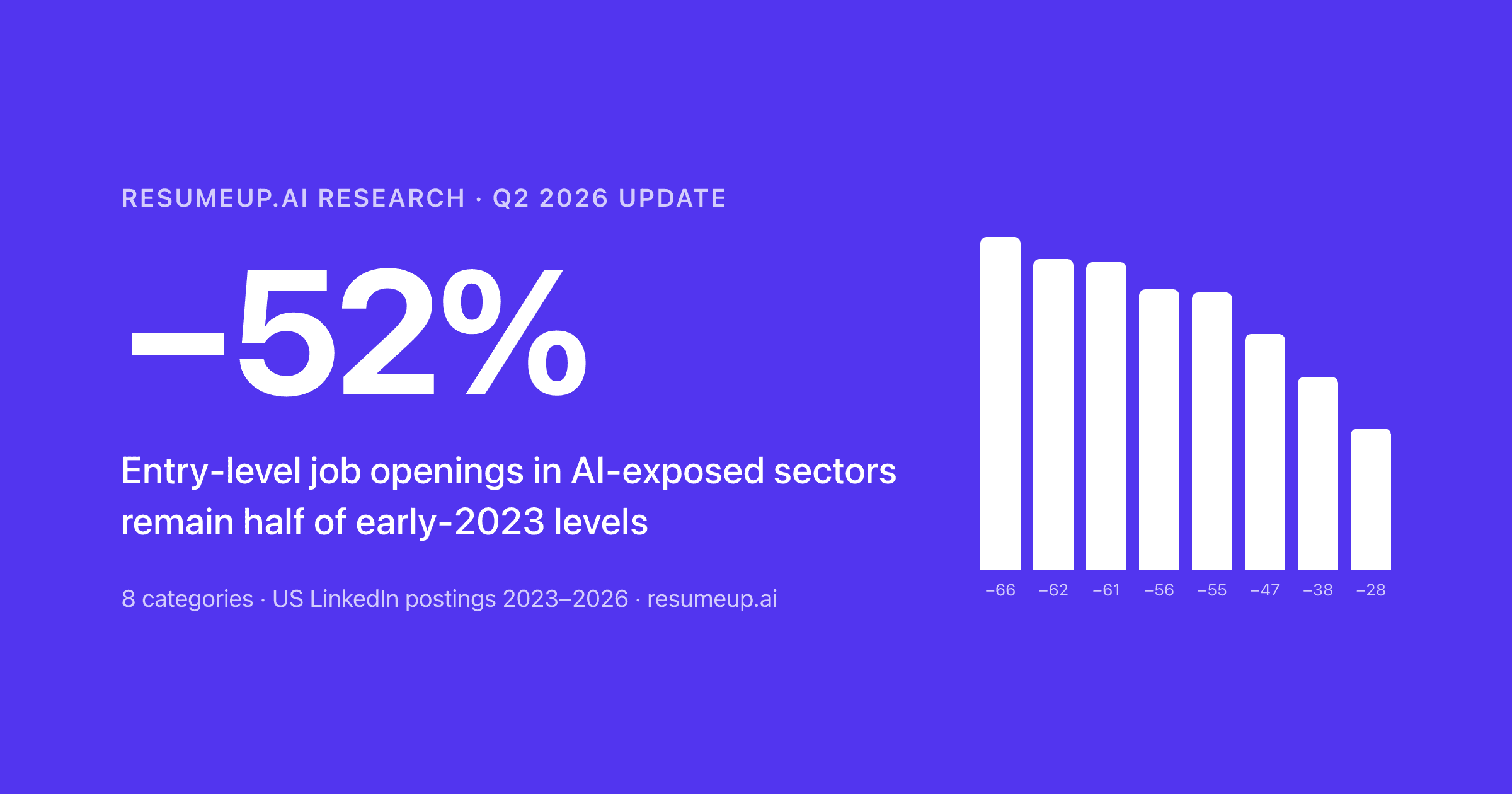
TL;DR: ResumeUp.AI tracked US entry-level LinkedIn job postings across eight AI-exposed categories, quarterly, from Q1 2023 through Q2 2026. By mid-2026 openings remained an average of 51.5% below early-2023 levels. The steep 2023–2024 decline has not reversed: several categories have stabilized and HR is recovering modestly, but none has returned to its Q1 2023 baseline — and marketing hit a new low in Q2 2026.

Key Statistics
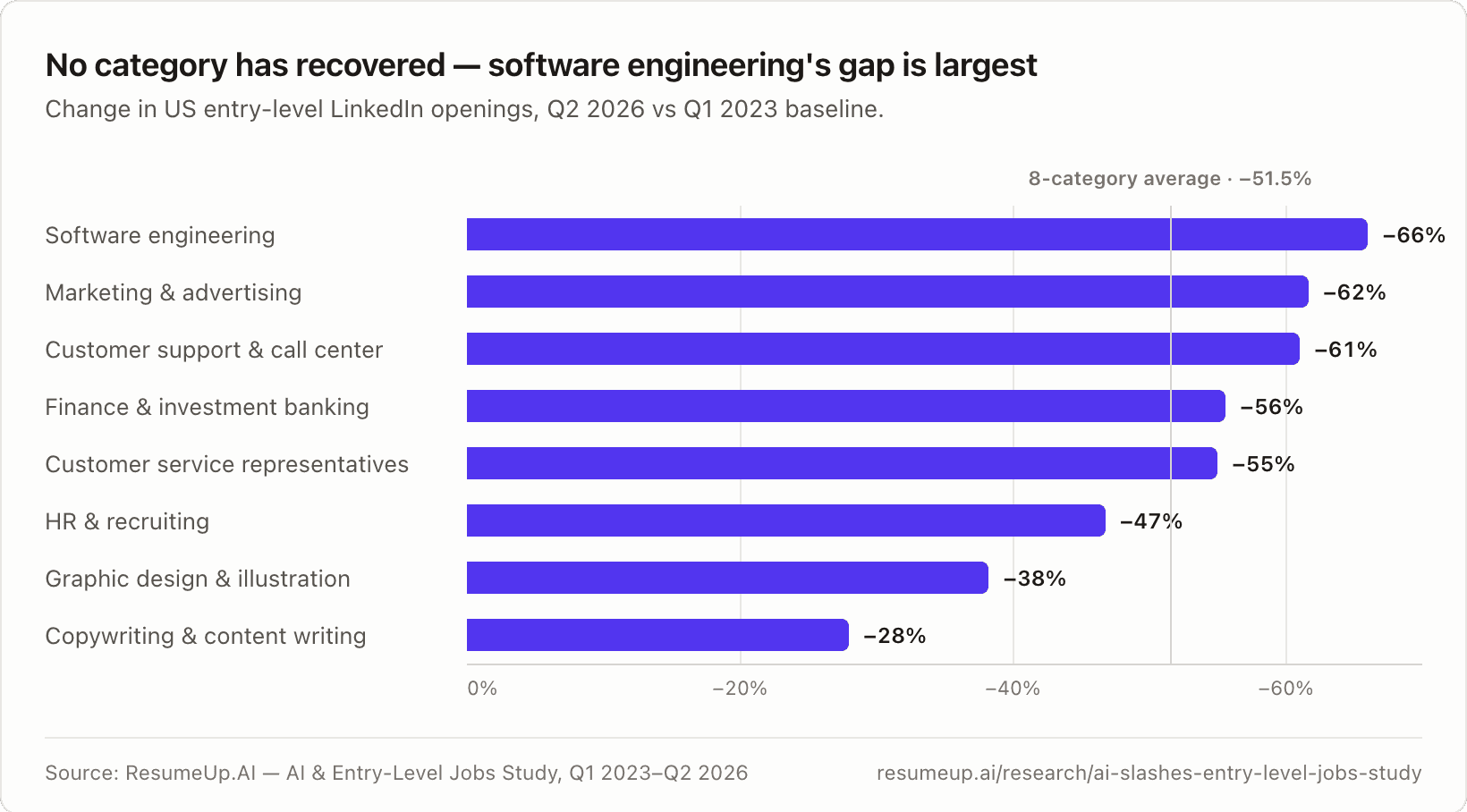
Entry-level openings across the eight categories were 51.5% below Q1 2023 levels by Q2 2026 — three and a half years into the generative-AI era, none has recovered to baseline.
Software engineering has the largest continuing gap: −66% (29,949 → 10,175 openings), despite a partial rebound from its Q4 2024 low of 8,488.
Marketing and advertising hit a new low in Q2 2026 — 6,800 openings, 62% below early 2023, the only category still clearly weakening.
Customer support and call center openings remain 61% below baseline (361,988 → 141,113) after the study's most dramatic collapse and partial recovery.
Copywriting is the most resilient category at −28% — the closest any sector has come to its 2023 level.
HR and recruiting is the clearest recovery story, improving for three straight quarters to −47%.

Change vs Q1 2023, by Category (Q2 2026)
Category | Q1 2023 | Lowest point | Decline at lowest | Q2 2026 | Change vs Q1 2023 |
|---|---|---|---|---|---|
Software engineering | 29,949 | 8,488 (Q4 2024) | −72% | 10,175 | −66% |
Marketing & advertising | 17,738 | 6,800 (Q2 2026) | −62% | 6,800 | −62% |
Customer support & call center | 361,988 | 76,446 (Q2 2024) | −79% | 141,113 | −61% |
Finance & investment banking | 66,264 | 23,234 (Q4 2024) | −65% | 29,429 | −56% |
Customer service representatives | 351,181 | 87,110 (Q2 2024) | −75% | 158,066 | −55% |
HR & recruiting | 27,244 | 10,499 (Q2 2024) | −61% | 14,503 | −47% |
Graphic design & illustration | 17,438 | 9,678 (Q3 2024) | −45% | 10,773 | −38% |
Copywriting & content writing | 10,758 | 6,118 (Q2 2025) | −43% | 7,749 | −28% |
Source: ResumeUp.AI analysis of US entry-level LinkedIn postings, Q1 2023 – Q2 2026. The two customer-related categories are separate LinkedIn searches and may contain overlapping listings; do not add them together.
A new analysis by ResumeUp.AI finds that entry-level job opportunities in sectors highly exposed to artificial intelligence remained dramatically below early-2023 levels through the first half of 2026. The sharp decline recorded during 2023 and 2024 has not reversed: although some categories have stabilized or recovered modestly, hiring remains substantially below the levels recorded at the beginning of the study.
Software Engineering Remains 66% Below Its Q1 2023 Level
Entry-level software engineering recorded one of the steepest declines in the study. Openings fell from 29,949 in Q1 2023 to a low of 8,488 in Q4 2024 — a 72% reduction — recovered to 11,848 by Q3 2025, then settled at approximately 10,175 by Q2 2026, leaving opportunities 66% below the baseline.
"Software engineering is not disappearing, but the traditional pathway into the profession appears to be narrowing," said Rohith Reddy, co-founder of ResumeUp.AI. "AI coding assistants allow experienced engineers to complete more implementation work, which may reduce the number of junior developers needed for routine coding, testing and documentation."
This entry-level weakness does not necessarily mean demand for software professionals will decline long term. The US Bureau of Labor Statistics still projects growth in software-related occupations, partly because of investment in AI, automation, and cybersecurity. The findings point instead to a growing gap between demand for experienced professionals and the positions through which new graduates traditionally enter the industry.
Marketing Openings Fall to a New Low
Marketing and advertising held comparatively stable through 2023 before contracting through 2024, 2025, and early 2026. Openings fell from 17,738 in Q1 2023 to 7,899 in Q2 2025, ticked up to 8,861 in Q3 2025, then declined again:
Period | Marketing & advertising openings |
|---|---|
Q4 2025 | 8,553 |
Q1 2026 | 7,707 |
Q2 2026 | 6,800 |
The Q2 2026 total is a 62% reduction from Q1 2023 — and a new low for the category. Marketing teams increasingly use generative AI for research, first-draft content, campaign variations, audience segmentation, reporting, and performance analysis.
"Companies will continue hiring marketers, but fewer roles may be dedicated exclusively to routine execution," Reddy said. "Entry-level candidates are increasingly expected to combine creativity with analytics, automation and an understanding of AI-assisted workflows."
Customer Support Remains Among the Most Heavily Affected
Customer support and call center openings experienced the most dramatic decline in absolute numbers: from 361,988 in Q1 2023 to 76,446 in Q2 2024 (−79%), recovering to 155,782 by Q3 2025, then staying volatile through the first half of 2026:
Period | Customer support & call center openings |
|---|---|
Q4 2025 | 138,844 |
Q1 2026 | 148,231 |
Q2 2026 | 141,113 |
The Q2 2026 figure remains 61% below baseline. The separate customer service representative category stood at approximately 158,066 openings by Q2 2026, 55% below its Q1 2023 level of 351,181. (These two categories are different LinkedIn searches and may contain overlapping listings; their totals should not be added together.)
"Customer support was one of the first major functions where generative AI could immediately handle a meaningful share of repetitive work," Reddy said. "Chatbots can now answer frequently asked questions, summarize conversations, classify tickets and suggest responses before a human representative becomes involved."
Customer service work is more likely to be restructured than eliminated: companies still require human representatives for emotionally sensitive, complex, or high-value interactions.
Finance Openings Stabilize Near 29,000
Entry-level finance and investment banking openings fell from 66,264 in Q1 2023 to 23,234 in Q4 2024 (−65%), recovered to 32,876 in Q3 2025, and have since held relatively stable:
Period | Finance & investment banking openings |
|---|---|
Q4 2025 | 29,122 |
Q1 2026 | 30,005 |
Q2 2026 | 29,429 |
That leaves the category roughly 56% below baseline. AI tools increasingly perform financial research, extract information from reports, prepare preliminary models, summarize earnings calls, and automate elements of compliance and risk analysis. The pressure is concentrated in junior roles built around repetitive analysis and document preparation — not finance employment as a whole.
HR and Recruiting Shows a Gradual Recovery
HR and recruiting declined from 27,244 in Q1 2023 to 10,499 in Q2 2024 (−61%), then posted three consecutive quarters of improvement in the most recent data:
Period | HR & recruiting openings |
|---|---|
Q4 2025 | 13,604 |
Q1 2026 | 14,055 |
Q2 2026 | 14,503 |
Even with this recovery, openings remain approximately 47% below baseline. AI is increasingly used to write job descriptions, search candidate databases, summarize interviews, schedule meetings, and automate candidate communication.
"The recruiting roles most likely to remain valuable are those involving candidate relationships, hiring strategy, employer branding and complex judgment," Reddy said. "The administrative portion of recruiting is becoming much easier to automate."
Copywriting Is the Most Resilient Category
Copywriting and content writing remained closest to its Q1 2023 level. Openings fell from 10,758 to 6,118 in Q2 2025 (−43%), rebounded sharply to 9,806 in Q3 2025, then cooled:
Period | Copywriting & content writing openings |
|---|---|
Q4 2025 | 8,067 |
Q1 2026 | 7,924 |
Q2 2026 | 7,749 |
At the Q2 2026 level, openings remain 28% below baseline — the smallest gap in the study. Generative AI has transformed content production, but demand persists for people who provide original research, editorial judgment, brand knowledge, subject-matter expertise, and distinctive creative direction.
"The value of simply producing a first draft has fallen," Reddy said. "But the value of deciding what should be said, verifying whether it is accurate and shaping it for a specific audience remains difficult to automate."
Graphic Design Stabilizes Below Its Baseline
Graphic design and illustration declined from 17,438 in Q1 2023 to 9,678 in Q3 2024 (−45%), and has held relatively steady since:
Period | Graphic design & illustration openings |
|---|---|
Q4 2025 | 10,621 |
Q1 2026 | 10,937 |
Q2 2026 | 10,773 |
The Q2 2026 figure sits approximately 38% below baseline. AI image tools now produce concepts, resize creative assets, remove backgrounds, and generate basic marketing visuals — but companies still need designers to maintain visual consistency, understand brand systems, and make creative decisions across campaigns and products.
The Decline Cannot Be Attributed to AI Alone
The study identifies a strong decline in job postings during a period of rapid AI adoption, but it does not establish that AI caused the entire reduction. The labor market was also affected by higher interest rates, economic uncertainty, post-pandemic overhiring, reduced employee turnover, and a broader slowdown in white-collar recruitment.
The results should be read as evidence of a changing labor market in AI-exposed sectors — not proof that every missing job was directly eliminated by AI. AI likely intensified the decline by allowing companies to automate routine work and operate with smaller teams, but broader economic conditions also played a significant role. Independent research points the same direction: Stanford's Digital Economy Lab finds employment declines for 22–25-year-olds concentrated in AI-exposed occupations, with its February 2026 update attributing the AI-linked portion to 2024 onward.
AI Skills Are Becoming a Requirement Across More Roles
Even as overall hiring remains subdued, employers increasingly ask candidates to demonstrate AI-related skills, with AI terminology appearing more often in software, data, analytics, marketing, finance, and HR job descriptions. AI is not only eliminating or consolidating tasks — it is changing the qualifications employers expect.
"We are moving from a market where AI knowledge was an advantage to one where it is becoming a basic expectation in many professional roles," Reddy said. "Graduates do not necessarily need to become AI engineers, but they need to demonstrate that they can use AI responsibly and effectively within their field."
What the Findings Mean for Gen Z Graduates
The contraction creates a particular challenge for Gen Z because junior positions traditionally provide the experience required to progress into specialized roles. When companies automate foundational tasks, they may also remove the work through which graduates learn how an industry operates: a junior developer previously learned by fixing simple bugs; a junior marketer by preparing campaign reports; a new analyst by building preliminary spreadsheets. AI now performs significant portions of these tasks.
The risk is that employers keep seeking experienced candidates without maintaining enough positions through which inexperienced candidates can acquire that experience. Recent graduates should focus on demonstrating:
Practical experience using AI tools within their profession
The ability to review, correct, and improve AI-generated output
Strong communication, critical-thinking, and problem-solving skills
Domain expertise beyond operating general-purpose AI tools
Evidence of completed projects rather than qualifications alone
An understanding of where AI output can be unreliable, biased, or inappropriate
"The strongest candidates will not be those who avoid AI or those who depend on it completely," Reddy said. "They will be candidates who can use AI to work faster while still contributing judgment, creativity, accountability and human understanding."
Entry-Level Hiring Is Stabilizing — at a Much Lower Level
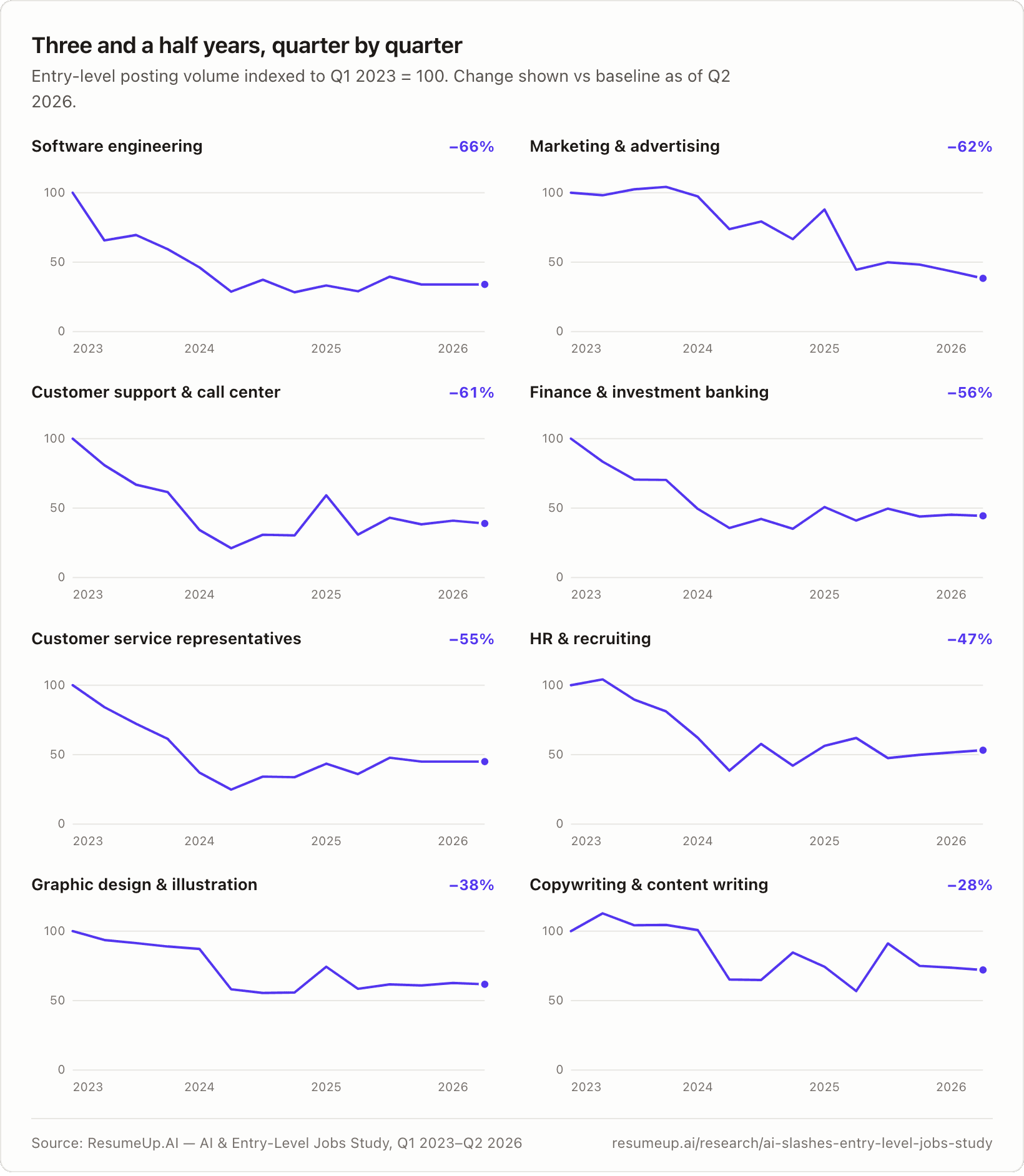
The most recent data does not indicate another uniform collapse. Software engineering, finance, graphic design, and customer service are broadly stable; HR and recruiting is recovering modestly; marketing continues to weaken. The rapid initial adjustment to generative AI appears to be moving into a second phase: instead of eliminating whole categories of employment, companies may be redesigning positions around smaller teams, higher productivity expectations, and greater AI proficiency.
For Gen Z, stabilization at substantially lower levels is still a difficult market. "Even if the decline stops, the number of available entry-level opportunities has already been reset in several industries," Reddy said. "The next challenge is ensuring that companies create new pathways for young people to build experience in an AI-enabled workplace."
Methodology
ResumeUp.AI analyzed US entry-level LinkedIn job-posting trends quarterly from Q1 2023 through Q2 2026, across eight searches representing sectors considered highly exposed to AI-assisted task automation: software engineering; marketing and advertising; HR and recruiting; finance and investment banking; copywriting and content writing; customer service representatives; graphic design and illustration; and customer support and call center. "Entry-level" reflects LinkedIn's experience-level tagging, which employers apply inconsistently. Posting counts measure advertised openings, not employment. The two customer-related categories are separate searches and may overlap.
Full Dataset: Entry-Level Job Postings by Category, Q1 2023 – Q2 2026
Period | Software Eng. | Marketing & Adv. | HR & Recruiting | Finance & IB | Copywriting | Customer Svc Reps | Graphic Design | Customer Support & CC |
|---|---|---|---|---|---|---|---|---|
Q1 2023 | 29,949 | 17,738 | 27,244 | 66,264 | 10,758 | 351,181 | 17,438 | 361,988 |
Q2 2023 | 19,668 | 17,407 | 28,399 | 55,296 | 12,139 | 295,649 | 16,320 | 292,735 |
Q3 2023 | 20,823 | 18,168 | 24,393 | 46,736 | 11,207 | 253,951 | 15,936 | 241,965 |
Q4 2023 | 17,751 | 18,485 | 22,106 | 46,575 | 11,241 | 215,382 | 15,506 | 222,442 |
Q1 2024 | 13,846 | 17,264 | 16,955 | 32,778 | 10,839 | 130,225 | 15,206 | 124,013 |
Q2 2024 | 8,614 | 13,091 | 10,499 | 23,676 | 7,009 | 87,110 | 10,134 | 76,446 |
Q3 2024 | 11,202 | 14,062 | 15,727 | 27,944 | 6,970 | 120,244 | 9,678 | 111,629 |
Q4 2024 | 8,488 | 11,804 | 11,468 | 23,234 | 9,099 | 118,499 | 9,751 | 109,974 |
Q1 2025 | 9,946 | 15,596 | 15,351 | 33,684 | 7,998 | 152,737 | 12,973 | 214,186 |
Q2 2025 | 8,691 | 7,899 | 16,899 | 27,198 | 6,118 | 126,513 | 10,200 | 111,874 |
Q3 2025 | 11,848 | 8,861 | 12,964 | 32,876 | 9,806 | 167,884 | 10,749 | 155,782 |
Q4 2025 | 10,175 | 8,553 | 13,604 | 29,122 | 8,067 | 158,066 | 10,621 | 138,844 |
Q1 2026 | 10,209 | 7,707 | 14,055 | 30,005 | 7,924 | 155,126 | 10,937 | 148,231 |
Q2 2026 | 10,771 | 6,800 | 14,503 | 29,429 | 7,749 | 158,716 | 10,773 | 141,113 |
Software engineering and customer service representative values for Q4 2025 – Q2 2026 reflect the most recent verified pull for those searches.
Cite This Study
ResumeUp.AI (2026). Entry-Level Job Openings in AI-Exposed Sectors, Q1 2023 – Q2 2026: Eight-Category LinkedIn Posting Analysis. https://resumeup.ai/research/ai-slashes-entry-level-jobs-study
You're welcome to reference any statistic on this page with attribution and a link to https://resumeup.ai/. Press inquiries: rohith@resumeup.ai.
Frequently Asked Questions
How much have entry-level jobs declined in AI-exposed sectors?
Across eight AI-exposed categories, US entry-level LinkedIn openings were an average of 51.5% below Q1 2023 levels by Q2 2026, per ResumeUp.AI's quarterly analysis. Declines at the lowest points ranged from 43% (copywriting) to 79% (customer support).
Which entry-level jobs are most affected by AI in 2026?
By mid-2026, software engineering had the largest remaining gap (−66% vs Q1 2023), followed by marketing and advertising (−62%, a new low), customer support and call centers (−61%), and finance (−56%).
Which entry-level jobs are least affected by AI?
Copywriting and content writing (−28% vs baseline) and graphic design (−38%) — roles where AI works as a production tool that still needs human direction, editorial judgment, and brand accountability rather than as a direct substitute.
Are entry-level jobs recovering in 2026?
Hiring is stabilizing at a much lower level rather than recovering. HR and recruiting improved for three straight quarters to −47%; software engineering, finance, graphic design, and customer service held broadly stable; marketing continued to weaken to a new low. No category has returned to its early-2023 baseline.
Is AI the only reason entry-level hiring declined?
No. Higher interest rates, post-pandemic overhiring corrections, reduced turnover, and a broader white-collar slowdown all contributed. The study's sector pattern — steepest declines where generative AI substitutes most directly — is consistent with AI as a major driver among several, matching Stanford's findings for young workers in AI-exposed occupations.
What should new graduates do about AI taking entry-level jobs?
Demonstrate practical AI-tool fluency within your field, the ability to review and improve AI output, completed projects over credentials alone, and judgment about where AI is unreliable. Employers increasingly treat AI skills as a baseline expectation rather than an advantage.
Sources

Rohith Reddy
Co-Founder
Rohith Reddy is the co-founder of ResumeUp.AI and a former hiring manager who conducted 500+ technical interviews over a decade at companies including ADP. His hiring-market research at ResumeUp — including studies on ghost jobs and AI's impact on entry-level hiring — has been covered by Entrepreneur. A Computer Science graduate, he writes about what recruiters and ATS systems actually reward, from both sides of the hiring table.
All Blogs
AI Slashes Entry-Level Job Market by Over 50% for Gen Z, Study Finds
ResumeUp.AI tracked 8 AI-exposed job categories from Q1 2023 to Q2 2026. Entry-level openings remain 52% below 2023 levels - software engineering is down 66%.
Rohith Reddy
Co-Founder
Rohith co-founded ResumeUp.AI after a decade building software and hiring engineers. He graduated from IIIT in Computer Science, then worked at ADP, YuppTV, and Paperguide — leading teams and conducting 500+ technical interviews as a hiring manager. He writes from both sides of the table: what recruiters actually look for, and what the candidate side of the resume actually feels like.
TL;DR: ResumeUp.AI tracked US entry-level LinkedIn job postings across eight AI-exposed categories, quarterly, from Q1 2023 through Q2 2026. By mid-2026 openings remained an average of 51.5% below early-2023 levels. The steep 2023–2024 decline has not reversed: several categories have stabilized and HR is recovering modestly, but none has returned to its Q1 2023 baseline — and marketing hit a new low in Q2 2026.
Key Statistics
Entry-level openings across the eight categories were 51.5% below Q1 2023 levels by Q2 2026 — three and a half years into the generative-AI era, none has recovered to baseline.
Software engineering has the largest continuing gap: −66% (29,949 → 10,175 openings), despite a partial rebound from its Q4 2024 low of 8,488.
Marketing and advertising hit a new low in Q2 2026 — 6,800 openings, 62% below early 2023, the only category still clearly weakening.
Customer support and call center openings remain 61% below baseline (361,988 → 141,113) after the study's most dramatic collapse and partial recovery.
Copywriting is the most resilient category at −28% — the closest any sector has come to its 2023 level.
HR and recruiting is the clearest recovery story, improving for three straight quarters to −47%.
Change vs Q1 2023, by Category (Q2 2026)
Category | Q1 2023 | Lowest point | Decline at lowest | Q2 2026 | Change vs Q1 2023 |
|---|---|---|---|---|---|
Software engineering | 29,949 | 8,488 (Q4 2024) | −72% | 10,175 | −66% |
Marketing & advertising | 17,738 | 6,800 (Q2 2026) | −62% | 6,800 | −62% |
Customer support & call center | 361,988 | 76,446 (Q2 2024) | −79% | 141,113 | −61% |
Finance & investment banking | 66,264 | 23,234 (Q4 2024) | −65% | 29,429 | −56% |
Customer service representatives | 351,181 | 87,110 (Q2 2024) | −75% | 158,066 | −55% |
HR & recruiting | 27,244 | 10,499 (Q2 2024) | −61% | 14,503 | −47% |
Graphic design & illustration | 17,438 | 9,678 (Q3 2024) | −45% | 10,773 | −38% |
Copywriting & content writing | 10,758 | 6,118 (Q2 2025) | −43% | 7,749 | −28% |
Source: ResumeUp.AI analysis of US entry-level LinkedIn postings, Q1 2023 – Q2 2026. The two customer-related categories are separate LinkedIn searches and may contain overlapping listings; do not add them together.
A new analysis by ResumeUp.AI finds that entry-level job opportunities in sectors highly exposed to artificial intelligence remained dramatically below early-2023 levels through the first half of 2026. The sharp decline recorded during 2023 and 2024 has not reversed: although some categories have stabilized or recovered modestly, hiring remains substantially below the levels recorded at the beginning of the study.
Software Engineering Remains 66% Below Its Q1 2023 Level
Entry-level software engineering recorded one of the steepest declines in the study. Openings fell from 29,949 in Q1 2023 to a low of 8,488 in Q4 2024 — a 72% reduction — recovered to 11,848 by Q3 2025, then settled at approximately 10,175 by Q2 2026, leaving opportunities 66% below the baseline.
"Software engineering is not disappearing, but the traditional pathway into the profession appears to be narrowing," said Rohith Reddy, co-founder of ResumeUp.AI. "AI coding assistants allow experienced engineers to complete more implementation work, which may reduce the number of junior developers needed for routine coding, testing and documentation."
This entry-level weakness does not necessarily mean demand for software professionals will decline long term. The US Bureau of Labor Statistics still projects growth in software-related occupations, partly because of investment in AI, automation, and cybersecurity. The findings point instead to a growing gap between demand for experienced professionals and the positions through which new graduates traditionally enter the industry.
Marketing Openings Fall to a New Low
Marketing and advertising held comparatively stable through 2023 before contracting through 2024, 2025, and early 2026. Openings fell from 17,738 in Q1 2023 to 7,899 in Q2 2025, ticked up to 8,861 in Q3 2025, then declined again:
Period | Marketing & advertising openings |
|---|---|
Q4 2025 | 8,553 |
Q1 2026 | 7,707 |
Q2 2026 | 6,800 |
The Q2 2026 total is a 62% reduction from Q1 2023 — and a new low for the category. Marketing teams increasingly use generative AI for research, first-draft content, campaign variations, audience segmentation, reporting, and performance analysis.
"Companies will continue hiring marketers, but fewer roles may be dedicated exclusively to routine execution," Reddy said. "Entry-level candidates are increasingly expected to combine creativity with analytics, automation and an understanding of AI-assisted workflows."
Customer Support Remains Among the Most Heavily Affected
Customer support and call center openings experienced the most dramatic decline in absolute numbers: from 361,988 in Q1 2023 to 76,446 in Q2 2024 (−79%), recovering to 155,782 by Q3 2025, then staying volatile through the first half of 2026:
Period | Customer support & call center openings |
|---|---|
Q4 2025 | 138,844 |
Q1 2026 | 148,231 |
Q2 2026 | 141,113 |
The Q2 2026 figure remains 61% below baseline. The separate customer service representative category stood at approximately 158,066 openings by Q2 2026, 55% below its Q1 2023 level of 351,181. (These two categories are different LinkedIn searches and may contain overlapping listings; their totals should not be added together.)
"Customer support was one of the first major functions where generative AI could immediately handle a meaningful share of repetitive work," Reddy said. "Chatbots can now answer frequently asked questions, summarize conversations, classify tickets and suggest responses before a human representative becomes involved."
Customer service work is more likely to be restructured than eliminated: companies still require human representatives for emotionally sensitive, complex, or high-value interactions.
Finance Openings Stabilize Near 29,000
Entry-level finance and investment banking openings fell from 66,264 in Q1 2023 to 23,234 in Q4 2024 (−65%), recovered to 32,876 in Q3 2025, and have since held relatively stable:
Period | Finance & investment banking openings |
|---|---|
Q4 2025 | 29,122 |
Q1 2026 | 30,005 |
Q2 2026 | 29,429 |
That leaves the category roughly 56% below baseline. AI tools increasingly perform financial research, extract information from reports, prepare preliminary models, summarize earnings calls, and automate elements of compliance and risk analysis. The pressure is concentrated in junior roles built around repetitive analysis and document preparation — not finance employment as a whole.
HR and Recruiting Shows a Gradual Recovery
HR and recruiting declined from 27,244 in Q1 2023 to 10,499 in Q2 2024 (−61%), then posted three consecutive quarters of improvement in the most recent data:
Period | HR & recruiting openings |
|---|---|
Q4 2025 | 13,604 |
Q1 2026 | 14,055 |
Q2 2026 | 14,503 |
Even with this recovery, openings remain approximately 47% below baseline. AI is increasingly used to write job descriptions, search candidate databases, summarize interviews, schedule meetings, and automate candidate communication.
"The recruiting roles most likely to remain valuable are those involving candidate relationships, hiring strategy, employer branding and complex judgment," Reddy said. "The administrative portion of recruiting is becoming much easier to automate."
Copywriting Is the Most Resilient Category
Copywriting and content writing remained closest to its Q1 2023 level. Openings fell from 10,758 to 6,118 in Q2 2025 (−43%), rebounded sharply to 9,806 in Q3 2025, then cooled:
Period | Copywriting & content writing openings |
|---|---|
Q4 2025 | 8,067 |
Q1 2026 | 7,924 |
Q2 2026 | 7,749 |
At the Q2 2026 level, openings remain 28% below baseline — the smallest gap in the study. Generative AI has transformed content production, but demand persists for people who provide original research, editorial judgment, brand knowledge, subject-matter expertise, and distinctive creative direction.
"The value of simply producing a first draft has fallen," Reddy said. "But the value of deciding what should be said, verifying whether it is accurate and shaping it for a specific audience remains difficult to automate."
Graphic Design Stabilizes Below Its Baseline
Graphic design and illustration declined from 17,438 in Q1 2023 to 9,678 in Q3 2024 (−45%), and has held relatively steady since:
Period | Graphic design & illustration openings |
|---|---|
Q4 2025 | 10,621 |
Q1 2026 | 10,937 |
Q2 2026 | 10,773 |
The Q2 2026 figure sits approximately 38% below baseline. AI image tools now produce concepts, resize creative assets, remove backgrounds, and generate basic marketing visuals — but companies still need designers to maintain visual consistency, understand brand systems, and make creative decisions across campaigns and products.
The Decline Cannot Be Attributed to AI Alone
The study identifies a strong decline in job postings during a period of rapid AI adoption, but it does not establish that AI caused the entire reduction. The labor market was also affected by higher interest rates, economic uncertainty, post-pandemic overhiring, reduced employee turnover, and a broader slowdown in white-collar recruitment.
The results should be read as evidence of a changing labor market in AI-exposed sectors — not proof that every missing job was directly eliminated by AI. AI likely intensified the decline by allowing companies to automate routine work and operate with smaller teams, but broader economic conditions also played a significant role. Independent research points the same direction: Stanford's Digital Economy Lab finds employment declines for 22–25-year-olds concentrated in AI-exposed occupations, with its February 2026 update attributing the AI-linked portion to 2024 onward.
AI Skills Are Becoming a Requirement Across More Roles
Even as overall hiring remains subdued, employers increasingly ask candidates to demonstrate AI-related skills, with AI terminology appearing more often in software, data, analytics, marketing, finance, and HR job descriptions. AI is not only eliminating or consolidating tasks — it is changing the qualifications employers expect.
"We are moving from a market where AI knowledge was an advantage to one where it is becoming a basic expectation in many professional roles," Reddy said. "Graduates do not necessarily need to become AI engineers, but they need to demonstrate that they can use AI responsibly and effectively within their field."
What the Findings Mean for Gen Z Graduates
The contraction creates a particular challenge for Gen Z because junior positions traditionally provide the experience required to progress into specialized roles. When companies automate foundational tasks, they may also remove the work through which graduates learn how an industry operates: a junior developer previously learned by fixing simple bugs; a junior marketer by preparing campaign reports; a new analyst by building preliminary spreadsheets. AI now performs significant portions of these tasks.
The risk is that employers keep seeking experienced candidates without maintaining enough positions through which inexperienced candidates can acquire that experience. Recent graduates should focus on demonstrating:
Practical experience using AI tools within their profession
The ability to review, correct, and improve AI-generated output
Strong communication, critical-thinking, and problem-solving skills
Domain expertise beyond operating general-purpose AI tools
Evidence of completed projects rather than qualifications alone
An understanding of where AI output can be unreliable, biased, or inappropriate
"The strongest candidates will not be those who avoid AI or those who depend on it completely," Reddy said. "They will be candidates who can use AI to work faster while still contributing judgment, creativity, accountability and human understanding."
Entry-Level Hiring Is Stabilizing — at a Much Lower Level
The most recent data does not indicate another uniform collapse. Software engineering, finance, graphic design, and customer service are broadly stable; HR and recruiting is recovering modestly; marketing continues to weaken. The rapid initial adjustment to generative AI appears to be moving into a second phase: instead of eliminating whole categories of employment, companies may be redesigning positions around smaller teams, higher productivity expectations, and greater AI proficiency.
For Gen Z, stabilization at substantially lower levels is still a difficult market. "Even if the decline stops, the number of available entry-level opportunities has already been reset in several industries," Reddy said. "The next challenge is ensuring that companies create new pathways for young people to build experience in an AI-enabled workplace."
Methodology
ResumeUp.AI analyzed US entry-level LinkedIn job-posting trends quarterly from Q1 2023 through Q2 2026, across eight searches representing sectors considered highly exposed to AI-assisted task automation: software engineering; marketing and advertising; HR and recruiting; finance and investment banking; copywriting and content writing; customer service representatives; graphic design and illustration; and customer support and call center. "Entry-level" reflects LinkedIn's experience-level tagging, which employers apply inconsistently. Posting counts measure advertised openings, not employment. The two customer-related categories are separate searches and may overlap.
Full Dataset: Entry-Level Job Postings by Category, Q1 2023 – Q2 2026
Period | Software Eng. | Marketing & Adv. | HR & Recruiting | Finance & IB | Copywriting | Customer Svc Reps | Graphic Design | Customer Support & CC |
|---|---|---|---|---|---|---|---|---|
Q1 2023 | 29,949 | 17,738 | 27,244 | 66,264 | 10,758 | 351,181 | 17,438 | 361,988 |
Q2 2023 | 19,668 | 17,407 | 28,399 | 55,296 | 12,139 | 295,649 | 16,320 | 292,735 |
Q3 2023 | 20,823 | 18,168 | 24,393 | 46,736 | 11,207 | 253,951 | 15,936 | 241,965 |
Q4 2023 | 17,751 | 18,485 | 22,106 | 46,575 | 11,241 | 215,382 | 15,506 | 222,442 |
Q1 2024 | 13,846 | 17,264 | 16,955 | 32,778 | 10,839 | 130,225 | 15,206 | 124,013 |
Q2 2024 | 8,614 | 13,091 | 10,499 | 23,676 | 7,009 | 87,110 | 10,134 | 76,446 |
Q3 2024 | 11,202 | 14,062 | 15,727 | 27,944 | 6,970 | 120,244 | 9,678 | 111,629 |
Q4 2024 | 8,488 | 11,804 | 11,468 | 23,234 | 9,099 | 118,499 | 9,751 | 109,974 |
Q1 2025 | 9,946 | 15,596 | 15,351 | 33,684 | 7,998 | 152,737 | 12,973 | 214,186 |
Q2 2025 | 8,691 | 7,899 | 16,899 | 27,198 | 6,118 | 126,513 | 10,200 | 111,874 |
Q3 2025 | 11,848 | 8,861 | 12,964 | 32,876 | 9,806 | 167,884 | 10,749 | 155,782 |
Q4 2025 | 10,175 | 8,553 | 13,604 | 29,122 | 8,067 | 158,066 | 10,621 | 138,844 |
Q1 2026 | 10,209 | 7,707 | 14,055 | 30,005 | 7,924 | 155,126 | 10,937 | 148,231 |
Q2 2026 | 10,771 | 6,800 | 14,503 | 29,429 | 7,749 | 158,716 | 10,773 | 141,113 |
Software engineering and customer service representative values for Q4 2025 – Q2 2026 reflect the most recent verified pull for those searches.
Cite This Study
ResumeUp.AI (2026). Entry-Level Job Openings in AI-Exposed Sectors, Q1 2023 – Q2 2026: Eight-Category LinkedIn Posting Analysis. https://resumeup.ai/research/ai-slashes-entry-level-jobs-study
You're welcome to reference any statistic on this page with attribution and a link to https://resumeup.ai/. Press inquiries: rohith@resumeup.ai.
Frequently Asked Questions
How much have entry-level jobs declined in AI-exposed sectors?
Across eight AI-exposed categories, US entry-level LinkedIn openings were an average of 51.5% below Q1 2023 levels by Q2 2026, per ResumeUp.AI's quarterly analysis. Declines at the lowest points ranged from 43% (copywriting) to 79% (customer support).
Which entry-level jobs are most affected by AI in 2026?
By mid-2026, software engineering had the largest remaining gap (−66% vs Q1 2023), followed by marketing and advertising (−62%, a new low), customer support and call centers (−61%), and finance (−56%).
Which entry-level jobs are least affected by AI?
Copywriting and content writing (−28% vs baseline) and graphic design (−38%) — roles where AI works as a production tool that still needs human direction, editorial judgment, and brand accountability rather than as a direct substitute.
Are entry-level jobs recovering in 2026?
Hiring is stabilizing at a much lower level rather than recovering. HR and recruiting improved for three straight quarters to −47%; software engineering, finance, graphic design, and customer service held broadly stable; marketing continued to weaken to a new low. No category has returned to its early-2023 baseline.
Is AI the only reason entry-level hiring declined?
No. Higher interest rates, post-pandemic overhiring corrections, reduced turnover, and a broader white-collar slowdown all contributed. The study's sector pattern — steepest declines where generative AI substitutes most directly — is consistent with AI as a major driver among several, matching Stanford's findings for young workers in AI-exposed occupations.
What should new graduates do about AI taking entry-level jobs?
Demonstrate practical AI-tool fluency within your field, the ability to review and improve AI output, completed projects over credentials alone, and judgment about where AI is unreliable. Employers increasingly treat AI skills as a baseline expectation rather than an advantage.