Ghost Jobs Statistics: More Than 1 in 4 US Job Listings Is Likely a "Ghost Job," ResumeUp.AI Study Finds
A new study by ResumeUp.AI reveals that 1 in every 4 job listings on LinkedIn are likely "ghost jobs" with no intention to hire.

TL;DR: ResumeUp.AI analyzed more than 980,000 LinkedIn job listings across 10 major US metros, Canada, the United Kingdom, and Australia. 27.4% of US listings — more than one in four — had been open for over 30 days with no sign of active hiring, the pattern typical of "ghost jobs." The study was covered by Entrepreneur.
Key Statistics
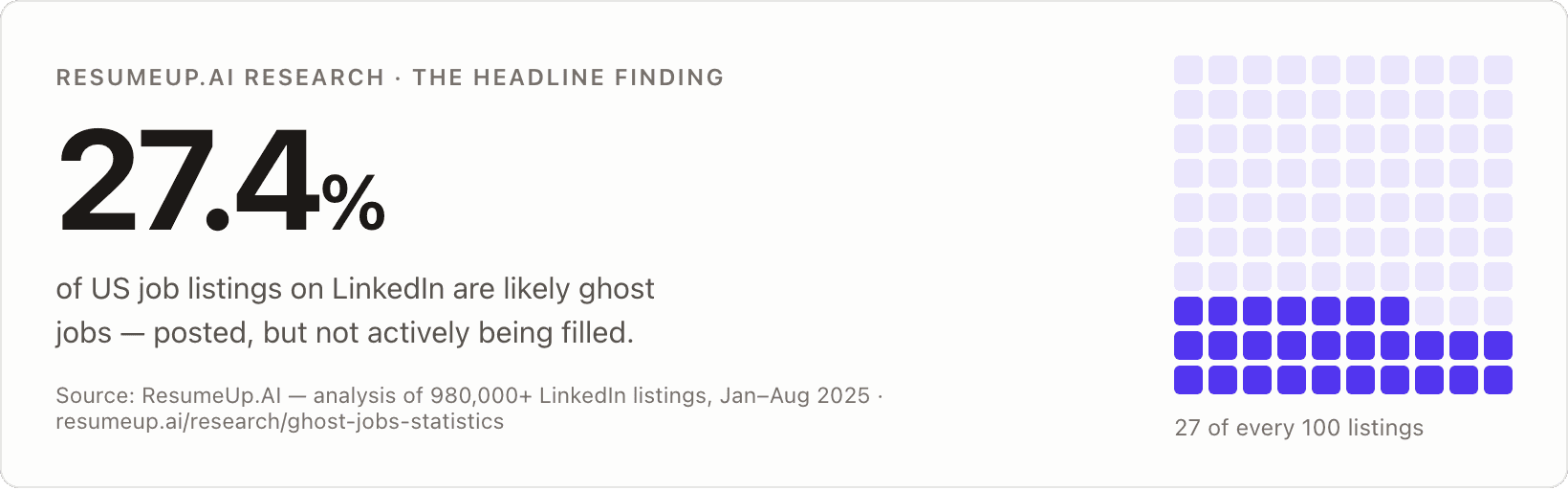
27.4% of US job listings on LinkedIn are likely ghost jobs — positions posted more than 30 days ago with no evidence of active hiring, based on ResumeUp.AI's analysis of listings posted January 1 – August 21, 2025.
Across the 10 major US metros studied, 81,148 of roughly 333,000 listings (24.4%) qualified as potential ghost jobs.
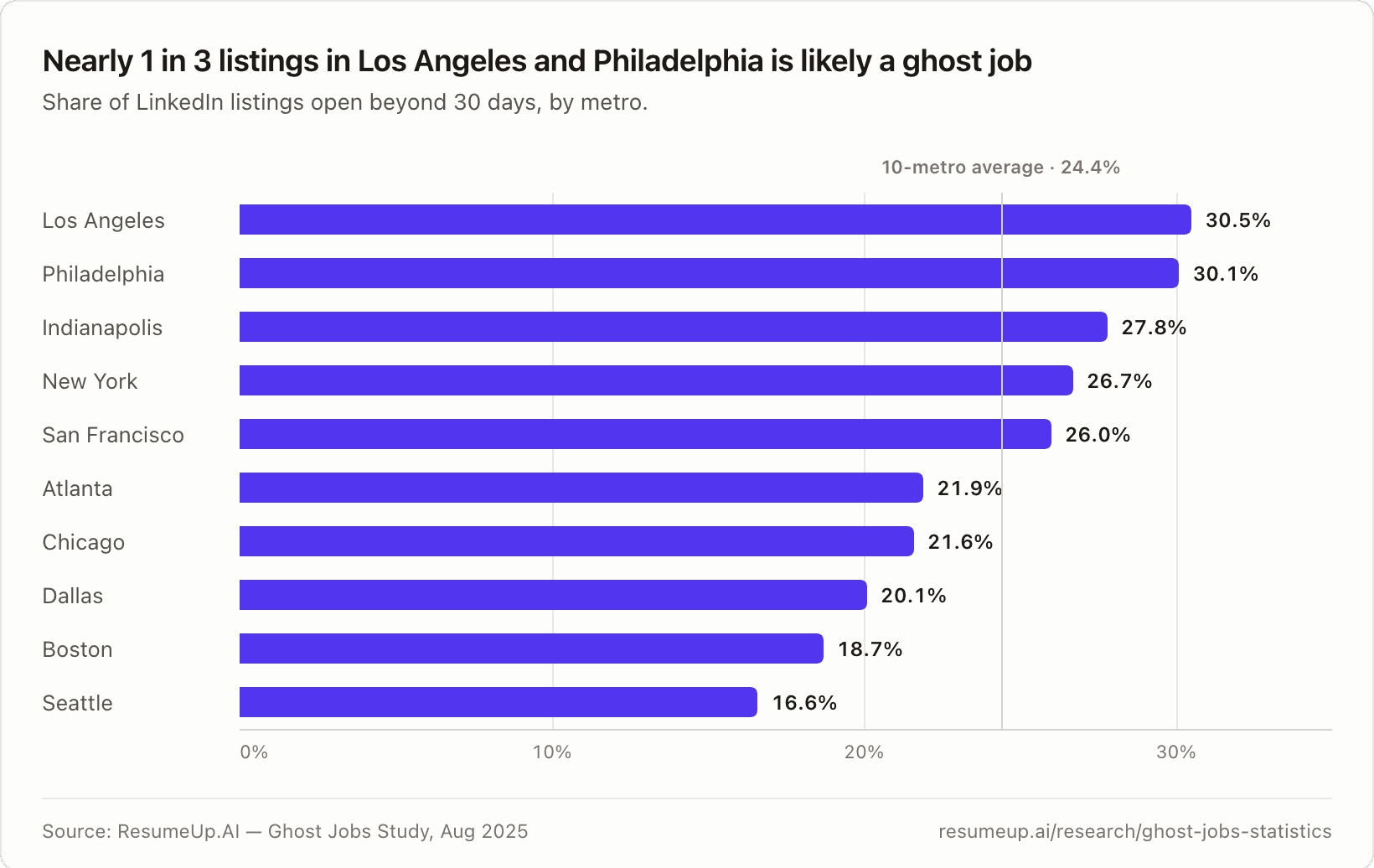
Los Angeles (30.5%) and Philadelphia (30.1%) have the highest ghost-job rates among major US cities — nearly one in three listings.
New York has the largest absolute number: 23,142 listings open beyond 30 days, 26.7% of the city's total.
Seattle has the healthiest market of the cities studied at 16.6%, followed by Boston at 18.7%.
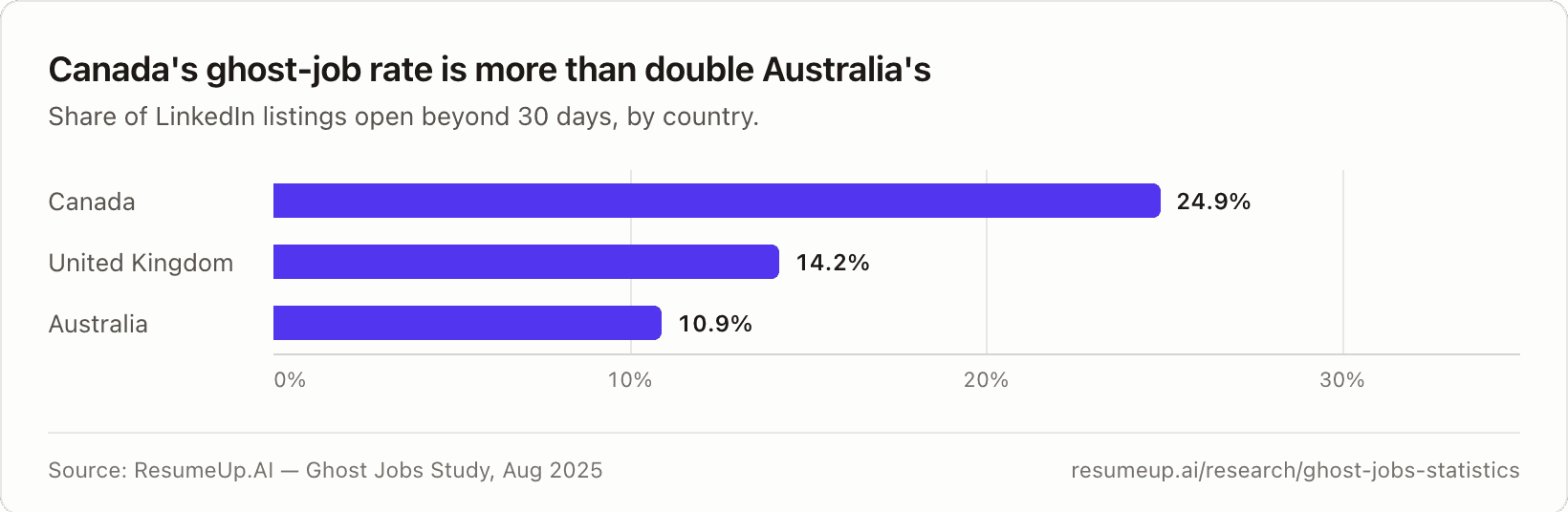
Canada's ghost-job rate (24.9%) is nearly double the UK's (14.2%) and more than double Australia's (10.9%).
ResumeUp.AI's estimate is consistent with independent research: ATS provider Greenhouse estimates 18–22% of all online job postings are ghost jobs.

What Is a Ghost Job?
A ghost job is a listing for a position the employer does not exist to fill — either the role was never real, or the company has no immediate plan to hire for it. The Congressional Research Service defines ghost postings as "online job postings for positions that do not exist, or that employers are not planning to fill immediately."
For job seekers, the cost is concrete: hours spent tailoring applications that go into a void. During the study period, the Bureau of Labor Statistics counted roughly 7.2 million open US positions — if more than a quarter of publicly listed roles aren't being actively filled, the real market is meaningfully smaller than the listings suggest.
Ghost Jobs Most Prevalent in Major US Metro Areas
The study found stark differences in ghost job rates across US cities. Los Angeles topped the list with 30.5% of its job listings classified as potential ghost jobs. This means nearly one-third of the 32,930 total job postings in Los Angeles may not represent active hiring opportunities.
Philadelphia followed closely behind with 30.1% of job listings qualifying as potential ghost jobs, while Indianapolis ranked third with 27.8% of listings remaining open beyond 30 days.
New York showed the highest absolute number of ghost jobs, with over 23,000 postings that have remained active beyond 30 days. This represents 26.7% of all job listings in the city.
San Francisco, a major tech hub, rounded out the top five cities with the highest percentage of ghost jobs at 26.0%.
Top 5 US Cities with Highest Percentage of Ghost Jobs
Rank | City | Percentage of Ghost Jobs | Total Number of Ghost Jobs |
|---|---|---|---|
1 | Los Angeles | 30.5% | 10,034 |
2 | Philadelphia | 30.1% | 6,198 |
3 | Indianapolis | 27.8% | 5,069 |
4 | New York | 26.7% | 23,142 |
5 | San Francisco | 26.0% | 6,528 |
Some Cities Show More Active Hiring Markets
Not all job markets are equally affected by ghost jobs. Seattle showed the lowest percentage of ghost jobs among the cities studied, with only 16.6% of listings remaining open beyond 30 days.
Boston had the second-lowest rate at 18.7%, while Dallas showed the third-lowest rate at 20.1%.
"The lower rates of ghost jobs in these cities may indicate more active hiring markets or more efficient talent acquisition practices," said Rohith, Founder of ResumeUp.AI. "Job seekers in these markets may have better odds of receiving responses to their applications."
Chicago and Atlanta rounded out the five cities with the lowest ghost job rates, at 21.6% and 21.9% respectively.
US Cities with Lowest Percentage of Ghost Jobs
Rank | City | Percentage of Ghost Jobs | Total Number of Ghost Jobs |
|---|---|---|---|
1 | Seattle | 16.6% | 3,546 |
2 | Boston | 18.7% | 4,593 |
3 | Dallas | 20.1% | 6,544 |
4 | Chicago | 21.6% | 8,180 |
5 | Atlanta | 21.9% | 7,314 |
Ghost Job Rates Vary by Country
The study also examined job markets in three countries. Canada showed the highest rate of ghost jobs at 24.9%, meaning about one in four of its 236,743 job listings may not represent active hiring opportunities.
The United Kingdom had a ghost job rate of 14.2%, substantially lower than Canada and most US cities studied.
Australia showed the lowest ghost job rate among countries at 10.9%, suggesting a more active hiring market or more efficient job posting practices in that country.
"The variation between countries is striking," Rohith noted. "Job seekers in the United Kingdom and Australia may face less competition from inactive listings compared to those in Canada and many US cities."
Ghost-Job Rates Vary Sharply by Country
The gap between countries was wider than the gap between US cities. Canada's rate of 24.9% — 58,846 of 236,743 listings — puts it in line with the worst US metros. The United Kingdom came in at 14.2%, and Australia at 10.9%, suggesting listings in those markets turn over faster and more reliably reflect active hiring.
Ghost-Job Rates by Country
Rank | Country | Ghost-Job Rate | Ghost-Job Listings | Total Listings Analyzed |
|---|---|---|---|---|
1 | Canada | 24.9% | 58,846 | 236,743 |
2 | United Kingdom | 14.2% | 45,362 | ~319,000 |
3 | Australia | 10.9% | 10,645 | ~98,000 |
Source: ResumeUp.AI, 2026.
"The variation between countries is striking," Rohith noted. "Job seekers in the United Kingdom and Australia may face less competition from inactive listings compared to those in Canada and many US cities."
How These Findings Compare With Other Research
ResumeUp.AI's estimate sits at the higher end of a converging body of evidence:
Greenhouse, the applicant tracking system used by thousands of employers, estimates 18–22% of all online job postings are ghost jobs, with rates reaching 38% in construction and 34% in the arts.
The Congressional Research Service flagged ghost postings as a growing labor-market concern in an April 2025 report, noting they may violate Section 5 of the FTC Act's prohibition on deceptive practices — though proving an employer's intent makes enforcement difficult.
Peer-reviewed work in Business Economics has begun quantifying the labor-market distortions ghost postings cause, including wasted search effort and misleading vacancy statistics.
The 30-day threshold used in this study is deliberately a broad net (see Limitations), which is why the headline figure runs a few points above Greenhouse's survey-based estimate — but every serious attempt to measure the problem lands between one in six and one in four listings.
Why Companies Post Jobs They Don't Fill
According to the Congressional Research Service and ResumeUp.AI's own analysis, ghost jobs exist for several reasons:
Resume pipelining — collecting candidates for openings that may materialize later.
Market intelligence — gauging salary expectations and available talent without a live vacancy.
Signaling growth — active listings make a company look healthy to investors, competitors, and current staff.
Stale and duplicated listings — roles filled or frozen but never taken down, and job boards auto-copying postings from other sites.
Third-party inventions — staffing agencies posting speculative roles to demonstrate reach, and outright scams impersonating real employers.
Regulators are starting to respond: New Jersey legislators introduced bills in 2024 that would force employers to disclose whether a posting reflects a real vacancy and remove filled listings within two weeks.
"These findings confirm what many job seekers have suspected — a substantial number of online job postings are not actively being filled," said Reddy. "Companies often keep job listings active for various reasons, such as collecting resumes for future openings, gauging market salary expectations, or maintaining appearances of company growth."
What Job Seekers Should Do
"For job seekers, this means many applications go into a black hole," Reddy added. "The best strategy is to focus on recently posted jobs, leverage networking opportunities, and use tools that help identify which companies are actively hiring."
Practical filters that follow directly from the data:
Prioritize listings posted within the last two weeks. The younger a posting, the more likely hiring is active.
Treat 30+ day listings as low-probability, not zero — some reflect genuinely hard-to-fill roles — and don't spend your best tailoring effort on them.
Check for signs of life: a named recruiter, recent company posts about the team, the role appearing on the company's own careers page.
Weight your search toward active markets. The same effort goes further in Seattle (16.6% ghost rate) than in Los Angeles (30.5%).
Methodology
ResumeUp.AI collected LinkedIn job listings in late August 2025 for 10 major US metropolitan areas (Los Angeles, Philadelphia, Indianapolis, New York, San Francisco, Atlanta, Chicago, Dallas, Boston, Seattle) and three countries (Canada, the United Kingdom, Australia). The window covered listings posted between January 1 and August 21, 2025 — 233 days.
For each market, listings were bucketed by posting age (30, 60, 90, 120, and 233 days). A listing posted more than 30 days before collection was classified as a potential ghost job, reflecting the point at which a posting outlives a typical active hiring cycle. Each market's ghost-job rate is the number of 30+ day listings divided by all listings posted in the 233-day window. In total, the analysis covered more than 980,000 listings.
Limitations
LinkedIn only. Rates may differ on other boards and on company career sites.
Reposting isn't captured. A company that deletes and reposts the same stale role monthly would appear as a fresh listing.
Point-in-time snapshot. Data reflects January–August 2025; market conditions shift.
Cite This Study
ResumeUp.AI (2025). Ghost Jobs Statistics: Analysis of 980,000+ LinkedIn Job Listings Across the US, Canada, UK, and Australia. https://resumeup.ai/research/ghost-jobs-statistics
You're welcome to reference any statistic on this page with attribution and a link. The full dataset is available upon request. For press inquiries or custom cuts of the data, contact rohith@resumeup.ai.
Media coverage: Entrepreneur — "1 in 4 Job Listings on LinkedIn Are Likely 'Ghost Jobs,' According to a New Report"
Frequently Asked Questions
What percentage of job listings are ghost jobs?
ResumeUp.AI's 2025 analysis of 980,000+ LinkedIn listings found 27.4% of US listings were likely ghost jobs — open more than 30 days with no sign of active hiring. Independent estimates from Greenhouse put the figure at 18–22% of all online postings, so roughly one in four to one in five listings.
What is a ghost job?
A ghost job is a posting for a role the employer isn't actively trying to fill — the position may not exist, may already be filled, or may be on hold. The Congressional Research Service defines ghost postings as listings "for positions that do not exist, or that employers are not planning to fill immediately."
How can you spot a ghost job?
Warning signs include a posting date more than 30 days old, no named recruiter or hiring manager, the role missing from the company's own careers page, vague responsibilities that could fit any team, and a listing that reappears month after month. Prioritizing jobs posted within the last two weeks is the simplest filter.
Why do companies post ghost jobs?
Common reasons include building a resume pipeline for future openings, benchmarking salary expectations, projecting an image of growth, forgetting to remove filled roles, and third parties (job boards, staffing agencies, scammers) duplicating or inventing listings.
Are ghost jobs illegal?
Generally no, though that is shifting. The Congressional Research Service notes deceptive postings may violate Section 5 of the FTC Act, and New Jersey introduced legislation in 2024 requiring employers to disclose whether postings reflect real vacancies and to remove filled listings within two weeks.
Which US city has the most ghost jobs?
By rate, Los Angeles (30.5% of listings) and Philadelphia (30.1%). By volume, New York, with 23,142 listings open beyond 30 days. Seattle had the lowest rate among the ten metros studied, at 16.6%.
Sources

Rohith Reddy
Co-Founder
Rohith Reddy is the co-founder of ResumeUp.AI and a former hiring manager who conducted 500+ technical interviews over a decade at companies including ADP. His hiring-market research at ResumeUp — including studies on ghost jobs and AI's impact on entry-level hiring — has been covered by Entrepreneur. A Computer Science graduate, he writes about what recruiters and ATS systems actually reward, from both sides of the hiring table.
All Blogs
Ghost Jobs Statistics: More Than 1 in 4 US Job Listings Is Likely a "Ghost Job," ResumeUp.AI Study Finds
A new study by ResumeUp.AI reveals that 1 in every 4 job listings on LinkedIn are likely "ghost jobs" with no intention to hire.
Rohith Reddy
Co-Founder
Rohith co-founded ResumeUp.AI after a decade building software and hiring engineers. He graduated from IIIT in Computer Science, then worked at ADP, YuppTV, and Paperguide — leading teams and conducting 500+ technical interviews as a hiring manager. He writes from both sides of the table: what recruiters actually look for, and what the candidate side of the resume actually feels like.
TL;DR: ResumeUp.AI analyzed more than 980,000 LinkedIn job listings across 10 major US metros, Canada, the United Kingdom, and Australia. 27.4% of US listings — more than one in four — had been open for over 30 days with no sign of active hiring, the pattern typical of "ghost jobs." The study was covered by Entrepreneur.
Key Statistics
27.4% of US job listings on LinkedIn are likely ghost jobs — positions posted more than 30 days ago with no evidence of active hiring, based on ResumeUp.AI's analysis of listings posted January 1 – August 21, 2025.
Across the 10 major US metros studied, 81,148 of roughly 333,000 listings (24.4%) qualified as potential ghost jobs.
Los Angeles (30.5%) and Philadelphia (30.1%) have the highest ghost-job rates among major US cities — nearly one in three listings.
New York has the largest absolute number: 23,142 listings open beyond 30 days, 26.7% of the city's total.
Seattle has the healthiest market of the cities studied at 16.6%, followed by Boston at 18.7%.
Canada's ghost-job rate (24.9%) is nearly double the UK's (14.2%) and more than double Australia's (10.9%).
ResumeUp.AI's estimate is consistent with independent research: ATS provider Greenhouse estimates 18–22% of all online job postings are ghost jobs.
What Is a Ghost Job?
A ghost job is a listing for a position the employer does not exist to fill — either the role was never real, or the company has no immediate plan to hire for it. The Congressional Research Service defines ghost postings as "online job postings for positions that do not exist, or that employers are not planning to fill immediately."
For job seekers, the cost is concrete: hours spent tailoring applications that go into a void. During the study period, the Bureau of Labor Statistics counted roughly 7.2 million open US positions — if more than a quarter of publicly listed roles aren't being actively filled, the real market is meaningfully smaller than the listings suggest.
Ghost Jobs Most Prevalent in Major US Metro Areas
The study found stark differences in ghost job rates across US cities. Los Angeles topped the list with 30.5% of its job listings classified as potential ghost jobs. This means nearly one-third of the 32,930 total job postings in Los Angeles may not represent active hiring opportunities.
Philadelphia followed closely behind with 30.1% of job listings qualifying as potential ghost jobs, while Indianapolis ranked third with 27.8% of listings remaining open beyond 30 days.
New York showed the highest absolute number of ghost jobs, with over 23,000 postings that have remained active beyond 30 days. This represents 26.7% of all job listings in the city.
San Francisco, a major tech hub, rounded out the top five cities with the highest percentage of ghost jobs at 26.0%.
Top 5 US Cities with Highest Percentage of Ghost Jobs
Rank | City | Percentage of Ghost Jobs | Total Number of Ghost Jobs |
|---|---|---|---|
1 | Los Angeles | 30.5% | 10,034 |
2 | Philadelphia | 30.1% | 6,198 |
3 | Indianapolis | 27.8% | 5,069 |
4 | New York | 26.7% | 23,142 |
5 | San Francisco | 26.0% | 6,528 |
Some Cities Show More Active Hiring Markets
Not all job markets are equally affected by ghost jobs. Seattle showed the lowest percentage of ghost jobs among the cities studied, with only 16.6% of listings remaining open beyond 30 days.
Boston had the second-lowest rate at 18.7%, while Dallas showed the third-lowest rate at 20.1%.
"The lower rates of ghost jobs in these cities may indicate more active hiring markets or more efficient talent acquisition practices," said Rohith, Founder of ResumeUp.AI. "Job seekers in these markets may have better odds of receiving responses to their applications."
Chicago and Atlanta rounded out the five cities with the lowest ghost job rates, at 21.6% and 21.9% respectively.
US Cities with Lowest Percentage of Ghost Jobs
Rank | City | Percentage of Ghost Jobs | Total Number of Ghost Jobs |
|---|---|---|---|
1 | Seattle | 16.6% | 3,546 |
2 | Boston | 18.7% | 4,593 |
3 | Dallas | 20.1% | 6,544 |
4 | Chicago | 21.6% | 8,180 |
5 | Atlanta | 21.9% | 7,314 |
Ghost Job Rates Vary by Country
The study also examined job markets in three countries. Canada showed the highest rate of ghost jobs at 24.9%, meaning about one in four of its 236,743 job listings may not represent active hiring opportunities.
The United Kingdom had a ghost job rate of 14.2%, substantially lower than Canada and most US cities studied.
Australia showed the lowest ghost job rate among countries at 10.9%, suggesting a more active hiring market or more efficient job posting practices in that country.
"The variation between countries is striking," Rohith noted. "Job seekers in the United Kingdom and Australia may face less competition from inactive listings compared to those in Canada and many US cities."
Ghost-Job Rates Vary Sharply by Country
The gap between countries was wider than the gap between US cities. Canada's rate of 24.9% — 58,846 of 236,743 listings — puts it in line with the worst US metros. The United Kingdom came in at 14.2%, and Australia at 10.9%, suggesting listings in those markets turn over faster and more reliably reflect active hiring.
Ghost-Job Rates by Country
Rank | Country | Ghost-Job Rate | Ghost-Job Listings | Total Listings Analyzed |
|---|---|---|---|---|
1 | Canada | 24.9% | 58,846 | 236,743 |
2 | United Kingdom | 14.2% | 45,362 | ~319,000 |
3 | Australia | 10.9% | 10,645 | ~98,000 |
Source: ResumeUp.AI, 2026.
"The variation between countries is striking," Rohith noted. "Job seekers in the United Kingdom and Australia may face less competition from inactive listings compared to those in Canada and many US cities."
How These Findings Compare With Other Research
ResumeUp.AI's estimate sits at the higher end of a converging body of evidence:
Greenhouse, the applicant tracking system used by thousands of employers, estimates 18–22% of all online job postings are ghost jobs, with rates reaching 38% in construction and 34% in the arts.
The Congressional Research Service flagged ghost postings as a growing labor-market concern in an April 2025 report, noting they may violate Section 5 of the FTC Act's prohibition on deceptive practices — though proving an employer's intent makes enforcement difficult.
Peer-reviewed work in Business Economics has begun quantifying the labor-market distortions ghost postings cause, including wasted search effort and misleading vacancy statistics.
The 30-day threshold used in this study is deliberately a broad net (see Limitations), which is why the headline figure runs a few points above Greenhouse's survey-based estimate — but every serious attempt to measure the problem lands between one in six and one in four listings.
Why Companies Post Jobs They Don't Fill
According to the Congressional Research Service and ResumeUp.AI's own analysis, ghost jobs exist for several reasons:
Resume pipelining — collecting candidates for openings that may materialize later.
Market intelligence — gauging salary expectations and available talent without a live vacancy.
Signaling growth — active listings make a company look healthy to investors, competitors, and current staff.
Stale and duplicated listings — roles filled or frozen but never taken down, and job boards auto-copying postings from other sites.
Third-party inventions — staffing agencies posting speculative roles to demonstrate reach, and outright scams impersonating real employers.
Regulators are starting to respond: New Jersey legislators introduced bills in 2024 that would force employers to disclose whether a posting reflects a real vacancy and remove filled listings within two weeks.
"These findings confirm what many job seekers have suspected — a substantial number of online job postings are not actively being filled," said Reddy. "Companies often keep job listings active for various reasons, such as collecting resumes for future openings, gauging market salary expectations, or maintaining appearances of company growth."
What Job Seekers Should Do
"For job seekers, this means many applications go into a black hole," Reddy added. "The best strategy is to focus on recently posted jobs, leverage networking opportunities, and use tools that help identify which companies are actively hiring."
Practical filters that follow directly from the data:
Prioritize listings posted within the last two weeks. The younger a posting, the more likely hiring is active.
Treat 30+ day listings as low-probability, not zero — some reflect genuinely hard-to-fill roles — and don't spend your best tailoring effort on them.
Check for signs of life: a named recruiter, recent company posts about the team, the role appearing on the company's own careers page.
Weight your search toward active markets. The same effort goes further in Seattle (16.6% ghost rate) than in Los Angeles (30.5%).
Methodology
ResumeUp.AI collected LinkedIn job listings in late August 2025 for 10 major US metropolitan areas (Los Angeles, Philadelphia, Indianapolis, New York, San Francisco, Atlanta, Chicago, Dallas, Boston, Seattle) and three countries (Canada, the United Kingdom, Australia). The window covered listings posted between January 1 and August 21, 2025 — 233 days.
For each market, listings were bucketed by posting age (30, 60, 90, 120, and 233 days). A listing posted more than 30 days before collection was classified as a potential ghost job, reflecting the point at which a posting outlives a typical active hiring cycle. Each market's ghost-job rate is the number of 30+ day listings divided by all listings posted in the 233-day window. In total, the analysis covered more than 980,000 listings.
Limitations
LinkedIn only. Rates may differ on other boards and on company career sites.
Reposting isn't captured. A company that deletes and reposts the same stale role monthly would appear as a fresh listing.
Point-in-time snapshot. Data reflects January–August 2025; market conditions shift.
Cite This Study
ResumeUp.AI (2025). Ghost Jobs Statistics: Analysis of 980,000+ LinkedIn Job Listings Across the US, Canada, UK, and Australia. https://resumeup.ai/research/ghost-jobs-statistics
You're welcome to reference any statistic on this page with attribution and a link. The full dataset is available upon request. For press inquiries or custom cuts of the data, contact rohith@resumeup.ai.
Media coverage: Entrepreneur — "1 in 4 Job Listings on LinkedIn Are Likely 'Ghost Jobs,' According to a New Report"
Frequently Asked Questions
What percentage of job listings are ghost jobs?
ResumeUp.AI's 2025 analysis of 980,000+ LinkedIn listings found 27.4% of US listings were likely ghost jobs — open more than 30 days with no sign of active hiring. Independent estimates from Greenhouse put the figure at 18–22% of all online postings, so roughly one in four to one in five listings.
What is a ghost job?
A ghost job is a posting for a role the employer isn't actively trying to fill — the position may not exist, may already be filled, or may be on hold. The Congressional Research Service defines ghost postings as listings "for positions that do not exist, or that employers are not planning to fill immediately."
How can you spot a ghost job?
Warning signs include a posting date more than 30 days old, no named recruiter or hiring manager, the role missing from the company's own careers page, vague responsibilities that could fit any team, and a listing that reappears month after month. Prioritizing jobs posted within the last two weeks is the simplest filter.
Why do companies post ghost jobs?
Common reasons include building a resume pipeline for future openings, benchmarking salary expectations, projecting an image of growth, forgetting to remove filled roles, and third parties (job boards, staffing agencies, scammers) duplicating or inventing listings.
Are ghost jobs illegal?
Generally no, though that is shifting. The Congressional Research Service notes deceptive postings may violate Section 5 of the FTC Act, and New Jersey introduced legislation in 2024 requiring employers to disclose whether postings reflect real vacancies and to remove filled listings within two weeks.
Which US city has the most ghost jobs?
By rate, Los Angeles (30.5% of listings) and Philadelphia (30.1%). By volume, New York, with 23,142 listings open beyond 30 days. Seattle had the lowest rate among the ten metros studied, at 16.6%.