All Blogs
Tsenta Review 2026: I Ran 25 Applications. Is It Worth It?
Tsenta auto-applies through real ATS portals from $19 a month. I ran 25 applications: what it got right, where matching failed, and a cheaper alternative.

If you have searched for an auto-apply tool in 2026, you have seen Tsenta. The promise is simple: it finds the job, tailors your resume, and submits the application before most people see the posting. The premise has data behind it. A corporate opening draws about 250 applications (Glassdoor), and LinkedIn's own numbers show candidates who apply within the first three days are 13% more likely to be hired. I wanted to find out whether Tsenta delivers on that promise.
So I tried Tsenta myself in September 2026 – ran it through 25 real job applications on the free tier and dug into every third-party review I could find on the paid plans. Here is what I found.
Disclosure: ResumeUp.AI is our own tool. We judged Tsenta on the same test and credited it where it leads.
Tsenta Review: The Short Version
Tsenta is a Y Combinator-backed (Summer 2026 batch) AI auto-apply agent from $19 a month, with resume tailoring, cover letters, and a job tracker included. You get 25 free applications with no credit card.
Where it falls short: weak job matching, missing resume details, generic cover letters, payment issues, and no verified third-party reviews yet.
Best for job seekers who want a high volume of applications submitted directly through company ATS portals, with the tailored materials shown to them before each one goes out.
The best alternatives are ResumeUp.AI, which scores every match from 0 to 100 before it applies and adds ATS checking, a LinkedIn optimizer, and mock interviews for $29 a month ($8.25 a month billed annually), and Koluvu.ai if auto-apply volume is your priority.
Quick Comparison: Tsenta vs ResumeUp.AI vs Koluvu.ai
Features | Tsenta | ResumeUp.AI | Koluvu.ai |
Best for | Pure auto-apply at high volume | Auto-apply with a visible match score plus the full toolkit | Fast auto-apply with resume tailoring |
Auto-Apply | ✅ | ✅ | ✅ |
ATS Resume checker | ⚠️ Generic score only | ✅ | ✅ |
Resume Tailoring | ⚠️ Single version, no templates | ✅ 20+ ATS-friendly templates | ✅ |
Cover Letter | ⚠️ Auto-generated, no customization | ✅ | ✅ |
LinkedIn Optimizer | ❌ | ✅ | ✅ |
Mock Interviews | ❌ | ✅ | ✅ |
Job Tracker | ✅ | ✅ | ✅ |
Starting Price | $19/mo | $29/mo ($8.25/mo annual) | $29/mo |
Pricing and features verified as of September 2026. We recheck this table quarterly, so if you spot something out of date, it's worth confirming on the vendor's own pricing page before you buy.
What Is Tsenta?
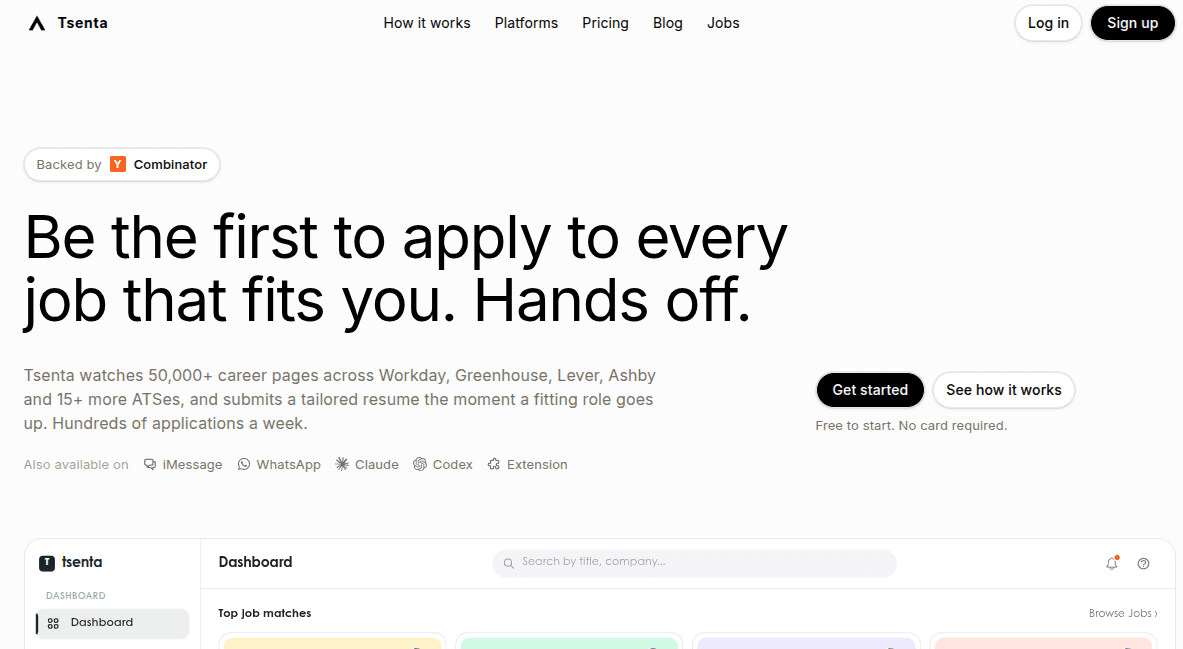
Tsenta is a Y Combinator-backed auto-apply agent, founded in 2026, that monitors 50,000+ company career pages around the clock and submits full applications through 19 ATS portals, including Workday, Greenhouse, Lever, and Ashby. Tsenta says that covers 75% or more of Fortune 500 job listings, and that it submits within 2 to 3 seconds of a matching role going live.
Unlike autofill extensions that stop at your name and email, Tsenta logs into the ATS, completes every field, answers screening questions in your voice, and hits submit. It shows you the changes it made before anything goes out and sends a receipt afterward with every field, answer, resume version, and timestamp.
Features
AI auto-apply agent that submits through 19 real ATS portals, including Workday, Greenhouse, Lever, and Ashby
Tailors your resume to every specific job description before submitting
Generates a cover letter for every application
Tracks every application with recruiter replies routed automatically
Works on web, iOS, Android, iMessage, WhatsApp, a Chrome extension, and a CLI
MCP integration so AI agents such as Claude Code can drive it
What Makes Tsenta Stand Out
Submits directly through 19 real ATS portals including Workday, Greenhouse, Lever, and Ashby
Gives a full receipt after every application – fields filled, resume version, and timestamp
Works from seven surfaces: web, iOS, Android, iMessage, WhatsApp, Chrome extension, and CLI
25 free applications with no credit card required
Resume tailoring and cover letters included in every plan
Where Tsenta Falls Short
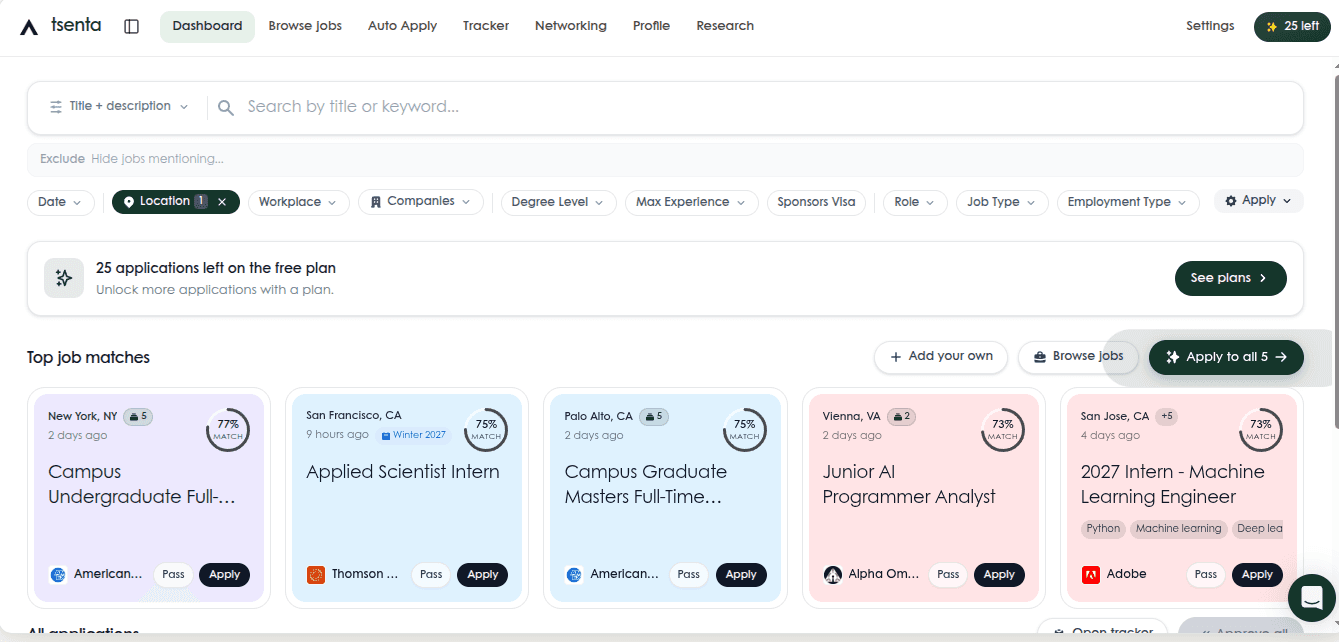
Job matching is weak. A senior NLP/AI Data Scientist resume was matched to undergraduate and intern roles with scores between 73% and 77%.
Resume extraction misses the basics. LinkedIn URL and university name were not picked up from the uploaded resume, which can hurt applications that ask for these details.
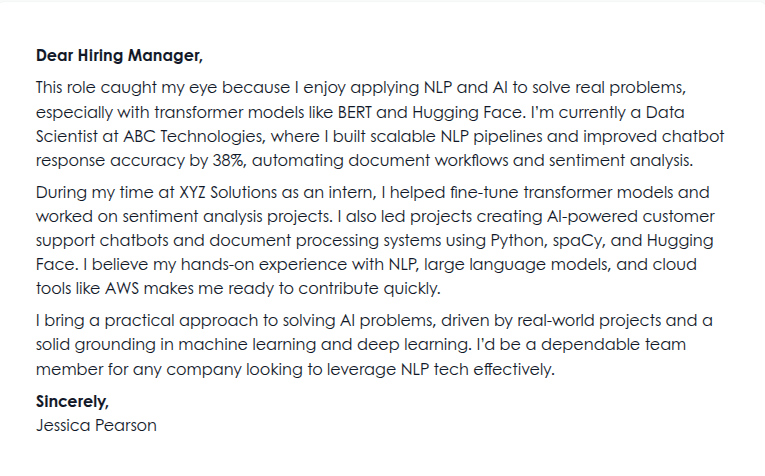
The cover letter is generic. The opening line and company name stay the same regardless of the role or employer – not what you expect from a tool that promises tailored applications.
Location filtering does not work correctly. Results showed roles across multiple cities despite the location being set to New York.
No LinkedIn optimizer, ATS resume checker, or mock interview feature. Tsenta is focused purely on applying – nothing else around the job search is covered.
New platform. Its Trustpilot profile has zero reviews, and there is no G2 or Capterra listing yet.
How Much Does Tsenta Cost?
Tsenta starts at $19 a month for 600 applications. Pro is $39 for 1,500 and Power is $99 for 4,500, all per 30-day cycle. Quarterly billing saves up to 32% and annual up to 36%.
Free Trial – 25 applications, no credit card required, full Pro features included
Plan | Monthly | Quarterly | Annually |
Starter | $19 | $49 | $159 |
Pro | $39 | $79 | $299 |
Power | $99 | $239 | $799 |
Every plan includes AI resume tailoring, cover letter generation, automated OTP filling, and priority support. Tiers differ only by volume – no features are locked behind higher plans.
Tsenta also sells one-time credit packs that never expire: $19 for 200 credits, $39 for 600, and $99 for 2,000. They suit an on-and-off search where a subscription would sit idle. Monthly prices and the free trial are on tsenta.com/pricing; the quarterly and annual figures above are what the checkout showed in September 2026.
What I Found After Testing Tsenta
I uploaded a test resume for a senior NLP/AI data scientist with five years of experience, based in New York, and ran it through the free tier. Here is what I found across three areas.
Resume Extraction
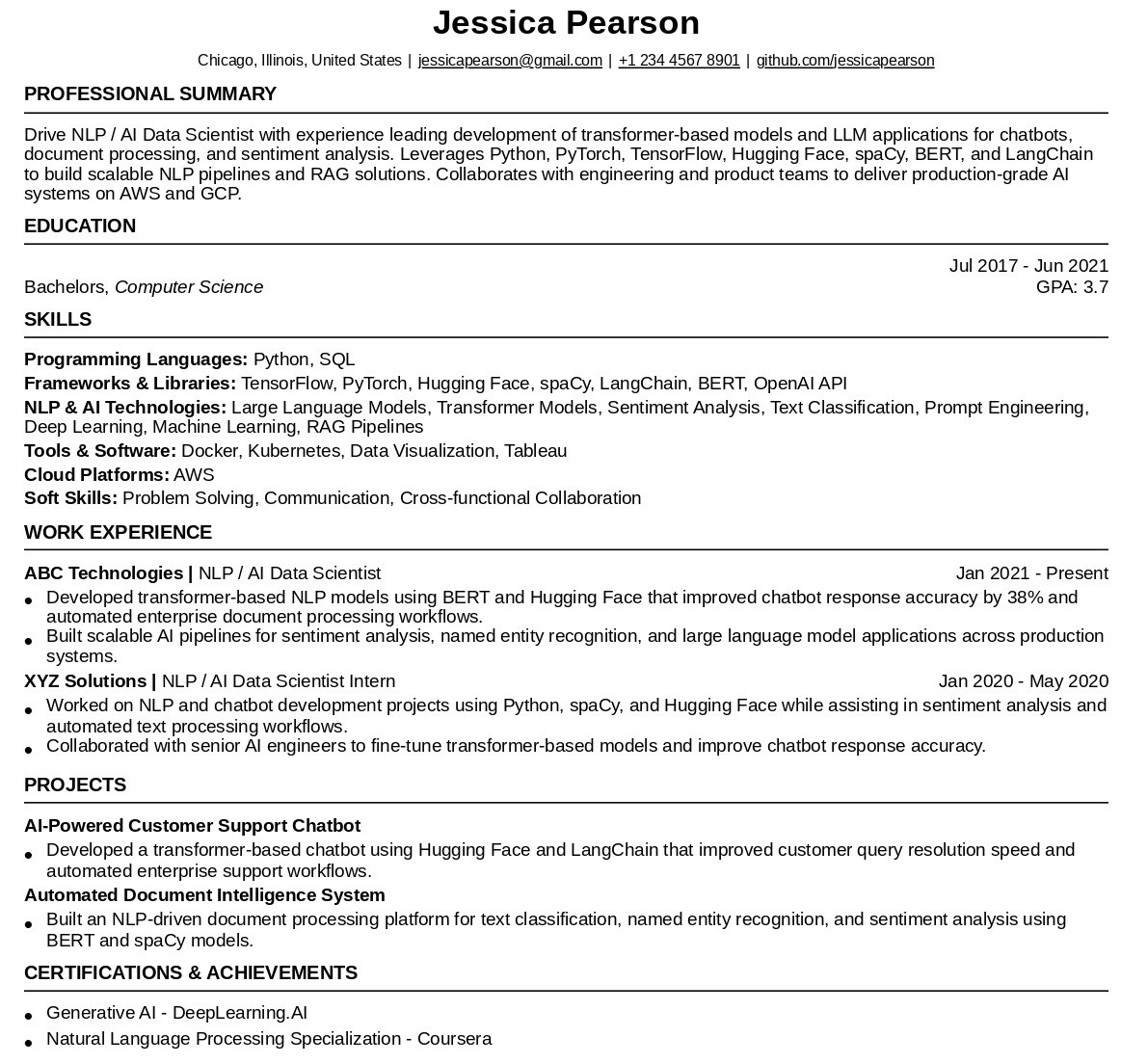
Tsenta handled the resume parsing better than expected in some areas and missed the basics in others. The skills section was the surprise: even though the skills were listed as a single block with no headings, it automatically organized them into neat categories like programming languages, frameworks, libraries, cloud platforms, and soft skills.
But it missed the basics. The LinkedIn URL was not extracted, and the university name was completely dropped from the generated resume – it just shows "Bachelors, Computer Science" with no institution name.
The cover letter was generated automatically, pulled real experience from the resume, and read professionally. The opening line "This role caught my eye" was generic enough to fit any job. For a tool that promises tailored applications, that is a gap.
Job Matching
This is where the results were most disappointing. After uploading a senior NLP/AI Data Scientist resume with 5 years of experience, Tsenta gave roles like Campus Undergraduate Full-Time, Campus Graduate Masters, and Applied Scientist Intern. These are entry-level and student roles. Match percentages came in between 73% and 77%, which is low for a strong, skills-heavy resume, and the scores gave no breakdown of why.
Volume does not fix this. Recruiters already describe "drinking through a fire hose," with popular roles pulling 300 to 500 applications in three days, per CNBC. Being applicant number four means nothing if the role is an internship. Weak matching is the one problem an auto-apply tool cannot afford.
Location Accuracy
The resume lists New York, USA, and the Location filter was set to New York. But the matched roles showed up in San Francisco, Palo Alto, Vienna, VA, and San Jose alongside New York. The location filter clearly did not work as expected – you would need to manually filter results every time before applying.
Is Tsenta Legit? Ratings and User Reviews
Tsenta is a real product: a Y Combinator Summer 2026 company that reportedly raised $500,000 from YC, with a working app that submits through real ATS portals. What it does not have yet is an independent review record.
Its Trustpilot profile exists but has zero reviews, and there is no G2 or Capterra listing. It is too new to judge from third-party ratings.
On the Google Play Store there are only a handful of reviews, and they are mixed. On Reddit, the feedback raises concerns worth reading before you pay.
What Users Are Saying
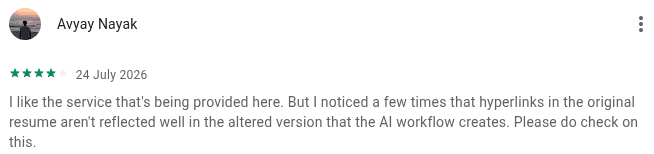
A 4-star Google Play reviewer noticed that hyperlinks from the original resume are not carried over correctly in the AI-generated version. This matches what we found in our own test.
A 1-star Google Play reviewer reported login bugs, a flawed website, and broken UPI payment options.

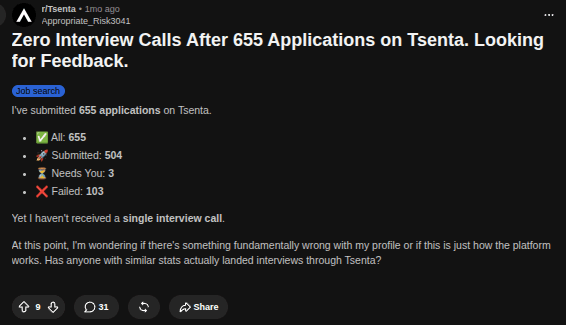
On Reddit, one user reported submitting 655 applications through Tsenta with zero interview calls. One account is not a pattern, but it matches the matching problem we saw in our own test.
What is the Best Alternative to Tsenta?
The best alternatives to Tsenta are ResumeUp.AI and Koluvu.ai.
ResumeUp.AI covers everything Tsenta does, including auto-apply, cover letters, and application tracking, and fixes the two things that went wrong in our Tsenta test. Its agent scores every new posting from 0 to 100 against your role, level, skills, location, and pay, shows which factors earned points, and applies only above the bar you set, so a senior resume does not go to intern roles. It also adds an AI resume builder, an ATS checker that scores against the exact role, a job description keyword finder, a free LinkedIn optimizer, mock interviews, and Chrome extension autofill. You can try it free with 20 credits; Pro is $29 a month, or $8.25 a month billed annually.
Koluvu.ai is the pick if pure auto-apply volume is your priority. It monitors more than 102,000 job sources, twice Tsenta's coverage, applies within about eight minutes of a role going live, and backs it with an interview guarantee (no interviews from your first 100 applications and you get a refund, as long as your profile is complete and the applications went out within 60 days). You get 10 free auto-applies with no credit card, and paid plans start at $29 a month.
Feature Comparison: Tsenta vs ResumeUp.AI vs Koluvu.ai
Auto-Apply: Speed and Volume
Speed: a draw on paper. Tsenta says it submits within 2 to 3 seconds of a role going live; Koluvu.ai says about eight minutes. Both are well inside the window that matters, since LinkedIn's data puts the hiring advantage on applying within three days, not seconds. In our test, Tsenta's speed was spent on the wrong roles, which is why matching decides this category, not the stopwatch.
Volume winner: Tsenta. It sends up to 4,500 applications a month on the Power plan, against Koluvu.ai's 1,000 on Autopilot Max. ResumeUp.AI works differently: you set a daily limit and a match bar, and the agent applies only to postings above it, so the count is whatever clears your bar.
Resume Quality and Tailoring
Winner: ResumeUp.AI. Its ATS Checker scores your resume against the exact job description, flags keyword gaps, and fixes them in one click across 20+ ATS-friendly templates.
Koluvu.ai rewrites your resume per application with premium templates and a free ATS score. Tsenta tailors per role but has no templates, generates only a single version, and missed the LinkedIn URL and university name in our test.
Beyond Applying: Full Job Search Toolkit
Winner: ResumeUp.AI and Koluvu.ai. Both cover the full job search – LinkedIn optimizer, mock interviews, cover letter generator, and job tracker all included in every paid plan. Tsenta is focused purely on applying and has none of these features.
Pricing
Winner: it depends on the billing period. Month to month, Tsenta's $19 Starter is the cheapest way to auto-apply, against $29 for ResumeUp.AI Pro and Koluvu.ai Pro. On an annual plan, ResumeUp.AI drops to $8.25 a month, 57% less than Tsenta Starter and 72% less than Koluvu.ai Pro, and the free tier includes 20 AI credits, unlimited resume scans, the job tracker, the LinkedIn score, and the Chrome extension.
The bigger difference is what the money buys. Tsenta and Koluvu.ai price by application volume. ResumeUp.AI's one plan covers the resume builder, ATS checker, cover letters, LinkedIn optimizer, mock interviews, tracker, and the agent together, so you are not paying separately for the tools that get the application read.
Which Should You Choose?
Want a complete job search toolkit with auto-apply, ATS optimization, LinkedIn optimizer, and mock interviews? ResumeUp.AI
Want the lowest annual price and every job search tool in one plan? ResumeUp.AI
Want an agent that applies within minutes of a role going live and guarantees an interview from your first 100? Koluvu.ai
Want pure auto-apply volume with direct ATS submission? Tsenta
Want to try auto-apply for free before paying? Tsenta (25 free applications) or Koluvu.ai (10 free auto-applies)
If you are comparing auto-apply tools, I have also reviewed JobHire.AI, LazyApply, AIApply, and LoopCV, and rounded up the best AI tools for job search.
Frequently Asked Questions
Is Tsenta legit?
Yes. Tsenta is a real Y Combinator Summer 2026 company with a working app that submits full applications through real ATS portals, and it shows you the changes before each one goes out. But it is new: its Trustpilot profile has zero reviews, there is no G2 or Capterra listing, and Google Play reviews mention login and payment bugs.
How much does Tsenta cost?
Tsenta starts at $19/month for 600 applications, $39/month for 1,500, and $99/month for 4,500. Quarterly and annual plans save up to 36%. One-time credit packs start at $19 for 200 credits and never expire. You get 25 free applications to try with no credit card.
Does Tsenta actually submit applications or just autofill?
It actually submits. Tsenta logs into the ATS, fills every field, answers screening questions, and hits submit. It is not an autofill extension like Simplify or Teal where you still click submit yourself.
What is the best alternative to Tsenta?
ResumeUp.AI is the best all-round alternative. Its agent scores every posting from 0 to 100 and applies only above the bar you set, and the same plan adds an ATS checker, LinkedIn optimizer, mock interviews, and cover letters for $29 a month ($8.25 a month billed annually). If auto-apply volume is your priority, Koluvu.ai applies within about eight minutes of a role going live and starts at $29 a month.
Is Tsenta worth it in 2026?
If high-volume direct ATS submission is what you need and you are comfortable with a new platform, start with the 25 free applications and watch which roles it picks. For most job seekers, ResumeUp.AI covers more of the search at a lower annual price and shows you why each job matched before it applies.

Rohith Reddy
Co-Founder
Rohith Reddy is the co-founder of ResumeUp.AI and a former hiring manager who conducted 500+ technical interviews over a decade at companies including ADP. His hiring-market research at ResumeUp — including studies on ghost jobs and AI's impact on entry-level hiring — has been covered by Entrepreneur. A Computer Science graduate, he writes about what recruiters and ATS systems actually reward, from both sides of the hiring table.